Category: Point of View

  • The Agent Operating Model: An Architecture View for GTM

    The Agent Operating Model: An Architecture View for GTM

    The architecture of agentic systems is starting to look more and more familiar.

    Spend enough time in ChatGPT, Claude, or Gemini, and you see many of the same patterns and building blocks repeating themselves: tools and connectors that let the model act, context assembled and compacted when it’s needed, specialized skills that can be loaded for a given task, and human approval before potentially dangerous actions.  Different labs are arriving at similar patterns because the underlying problems are the same.  Agents need context.  They need ways to execute things. They need guardrails, boundaries, and ways to align with their operators. And once more than one agent or task is involved, something has to coordinate the work across them.

    The same convergence is now showing up inside enterprises deploying GTM agents. In the influential Building Effective Agents, Anthropic distinguishes engineered workflows from more autonomous agents and when to use which.  Anthropic also describes patterns such as orchestrator-workers that coordinate multi-agent systems and evaluator-optimizers to check and improve work.  In its Well-Architected Agentic AI Lens, AWS formalizes model selection, cost controls, bounded autonomy, and human oversight required when moving agentic systems from prototypes into reliable, scaled production.  In Stacks on a Plane: Reshaping Martech on a Universal Data Layer, Scott Brinker describes martech moving toward a shared data and context substrate as agents need access not just to application data, but to the broader context required to understand customers, prior actions, and current state.

    MCP has become a common connection layer between agents and tools, replacing one-off integrations with a standard protocol for connecting AI systems to external data and applications. Registries, reusable skills, evaluation, and policy enforced outside the agent itself are increasingly recognizable parts of the stack.

    Across those approaches, a common set of elements keeps appearing:

    • Engineered workflows that define how work should flow
    • Orchestration to interpret intent, decompose work, and coordinate execution
    • Specialist agents focused on specific tasks rather than one agent trying to do everything
    • Model access and routing so different work can use different models fit for purpose as token subsidies go away
    • Shared context that gives agents the business, customer, and policy knowledge they need given their task
    • Reusable skills that formalize how recurring work gets done consistently
    • Tools and MCPs that let agents actually execute something in the world
    • A shared data foundation underneath the system
    • Governance, evaluation, and human oversight spanning the whole thing

    Marketing and GTM-specific versions are appearing as well, and we’re starting to see these components assembled in more consistent ways.  Ian Kim’s Agentic Marketing Blueprint is one of the clearest practitioner examples, combining a campaign backbone with orchestration, specialist agents and skills, context engineering, data, agent operations and governance.  BCG’s agentic marketing architecture approaches the problem from the CMO and organization transformation side, with a four-layer model spanning data, brand intelligence, agents and a unified marketer experience.  Omnicom and Adobe have begun productizing the model through their AI Agentic Operating Model, connecting orchestration, specialized agents, enterprise context, and governance across the full marketing lifecycle.

    Different starting points, but the same familiar ingredients: workflows, orchestration, specialist agents, context, tools, data, governance, and human oversight.  The question is how all of that actually comes together when agents start doing real GTM work and where human direction, verification, and accountability live in the system.

    How the Agent Operating Model fits together

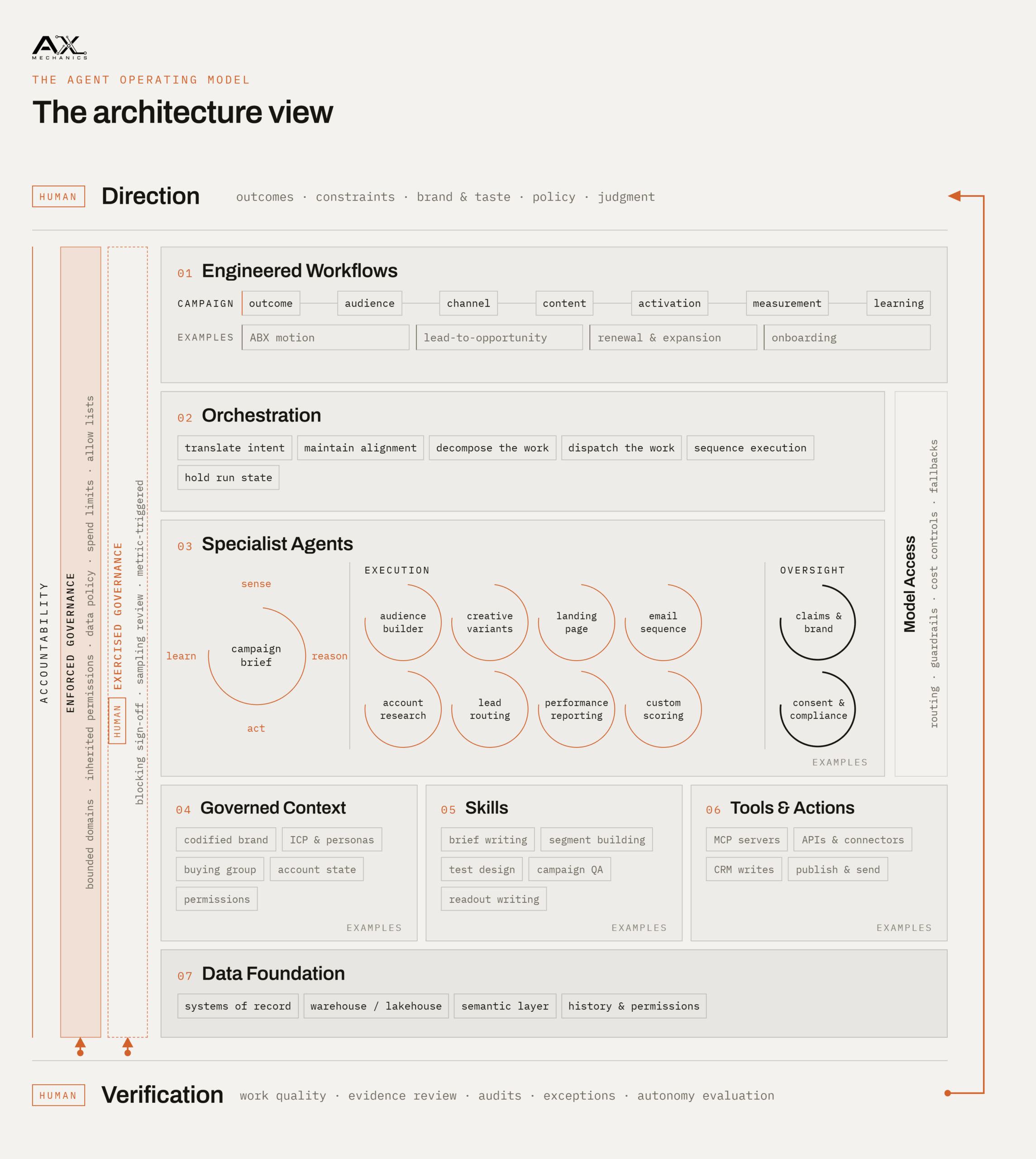
    The architecture that’s emerging has four structural parts:

    1. Seven operational layers are how the work runs: Engineered Workflows, Orchestration, Specialist Agents, Governed Context, Skills, Tools & Actions, and the Data Foundation.  Model Access sits across orchestration and agents because models are more of a modular resource that can be swapped out over time (frontier lab models, cloud-hosted, open-weight, or specialized models).
    2. Two human layers—Direction & Verification—bookend the system.  Humans establish the outcomes, constraints, policy, taste, and judgment that guide the work upfront.  Then humans evaluate the work, exceptions, and results coming back.  Some have started referring to this common AI workflow pattern (for better or for worse 😉) as the ‘human sandwich.’
    3. Governance & Accountability runs through every layer, because authority, permissions, limits, and review aren’t just a downstream compliance check at the end.  They determine what the system is allowed to do while it runs.
    4. A learning path closes the loop.  What happens in production feeds back into Direction, Governance, Context, Skills, and future Workflows.  That’s what allows the system to improve over time.
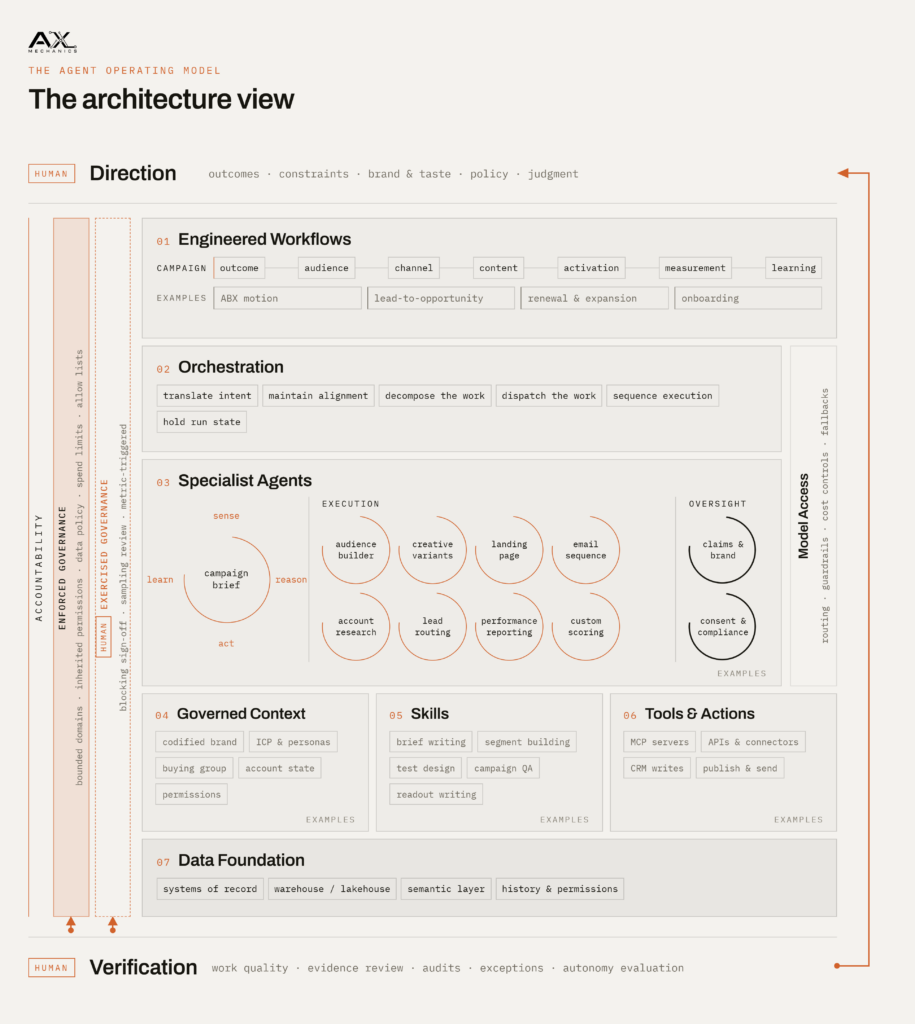
    Download the Operating Model

    01 — Engineered Workflows

    The first layer is the workflow. Take a marketing Campaign as an example workflow: it moves from outcome to audience, channel, content, activation, measurement, and learning.  Some of that work may be fixed and deterministic…some may require LLM reasoning or judgment…and some will still belong with people.  

    A Campaign is only one kind of workflow.  An ABM motion might have its own workflow.  So might a lead-to-opportunity handoff, where an inbound signal might trigger account research, qualification, an account brief, and a handoff to sales.  In practice, GTM work often crosses the organizational boundaries between marketing, sales, and customer success, which is why we think the workflow is a more useful unit of design than the campaign or an individual functional tool.

    We’ve written more about how to prioritize and re-engineer workflows for humans and agents in: Everyone Says Redesign the Work. No One Says How.

    02 — Orchestration

    In a martech world where everyone wants to start with tools, it helps to start by thinking of the Orchestrator as a role vs. a tool.  This has gotten murky because it’s emerging as a product category delivered in different flavors.  In the end, something has to translate human intent into a plan, keep the work aligned to the objective and constraints, break it into pieces, decide which agents or tools should do what, sequence the execution, and maintain the state of the run.  That’s orchestration whether it happens inside a suite-native platform (like Salesforce Agentforce or Adobe Agent Orchestrator), a hyperscaler (like AWS Bedrock or Google Vertex AI), a horizontal agent platform (like LangChain/LangSmith, Airtable Hyperagent, or WRITER), a domain-specific system of work (like Gradial, Typeface, or Clay), custom software or some combination of the above.

    That’s why the orchestration choice matters so much architecturally.  The Orchestrator sits in a privileged position: it sees the objective, the work, the agents, the context, and the actions.  Whoever owns that layer can end up owning a meaningful part of how your GTM organization actually works — which makes the choice important for governance, learning, and vendor lock-in.

    03 — Specialist Agents

    Below orchestration sit the agents doing the actual work.  The pattern is increasingly toward narrower specialists rather than one agent trying to do everything.  That makes the work easier to scope, the context easier to manage, and troubleshooting easier to diagnose. An audience builder, for example, has a very different job from an agent doing account research, generating creative, scoring leads, or analyzing performance.  Each can operate inside a bounded domain without needing to understand the entire GTM system.

    We also think oversight agents will become just as important as execution agents.  They can independently check claims against an approved set of criteria, test work against brand or policy rules, verify consent, or flag exceptions before something proceeds.  That helps scale review without requiring a person to inspect every output.  That said, oversight agents are a tool to extend review capacity.  They don’t replace human accountability.

    Model Access

    We treat Model Access as a shared layer across orchestration and specialist agents because the model itself shouldn’t become a fixed part of the architecture.  Different tasks have different needs for reasoning capability, speed, and cost, so the system should be able to swap or route work across models rather than hardwire everything to one provider.

    That’s already where the market is heading.  Databricks’ State of AI Agents telemetry found that by October 2025, 78% of companies on its platform were using two or more model families, and 59% were using three or more.  Multi-model environments are becoming the norm.

    Models will change quickly.  The architecture around them should be built to survive that.

    04 — Governed Context

    Governed Context is the shared knowledge agents need at the moment of work: brand, ICPs and personas, buying groups, account score, product specs, policies, permissions, and other business context.  The important point is that this shouldn’t be recreated inside every AI tool.  If brand voice or customer definitions live only inside the creative platform, then every other agent has to replicate it.  Another important consideration is the context engineering required to give the agent/model what it needs—and only what it needs—to avoid introducing noise and reducing predictable reasoning. 

    This also changes how we think about the CDP.  Its traditional data role is increasingly moving down into warehouses, lakehouses, and broader enterprise data platforms, while decisioning and activation are moving up into agentic systems.  The basic capabilities don’t disappear, but we may find that over time the platform matters less.  That’s why we separate Governed Context from the underlying Data Foundation rather than treating the CDP as a permanent layer.  Time will tell!

    05 — Skills

    If context is what an agent needs to know, a skill is how to do a repeatable kind of work.  It’s a codified playbook (usually in markdown) that describes the steps, methods, rules, tools, and guardrails an agent needs to accomplish a task consistently.  An ICP definition is context.  How to qualify an account against it is a skill.  Your brand voice is context.  How to turn a product brief into on-brand copy is a skill.

    Skills capture repeatable methods that agents can call when needed.  Keeping them separate allows us to manage context and keeps agents from becoming overloaded bundles of prompts, instructions, and knowledge.  It also makes them portable so they can be used with multiple agents and different models.  The agent is the actor…the skill is one of the methods it can use.

    06 — Tools & Actions

    At some point, the agent has to act: read or write to CRM, create a segment, publish content, send an email, update a page, or call another enterprise service.  This is where APIs, connectors, and MCP servers come in.

    MCP is useful because it gives agents a more standard way to connect to tools and systems instead of engineering every integration from scratch.  Just as important, the tool layer separates reasoning from execution: the agent decides what should happen, while the tool controls how that action is carried out and plays an important role in enforcing what the agent is actually allowed to do.  That distinction matters more as agents move from reading data to changing it.  The question is no longer just, “Can the agent access the CRM?”  It’s “What can it change, under whose authority, and with what controls?”

    07 — Data Foundation

    Underneath everything is the data foundation: systems of record, the warehouse or lakehouse, and the shared definitions that keep the business working from the same version of truth.  Agents don’t make the data problem go away.  If anything, they make bad data more consequential.  A stale dashboard gives you an old insight…a stale agent context can trigger the wrong action…and that can directly impact a customer experience. 

    The top of the stack will change quickly.  The foundation should be built to last.

    Governance operates in two modes

    Governance runs through every level of the system, not as a final approval step after the work is already designed.  We think about it in two modes: enforced governance and exercised governance.

    Enforced governance is what the system makes impossible to violate: permissions, data policies, allowed actions, and other hard boundaries.  If an agent isn’t allowed to access customer PII, the control shouldn’t be a prompt telling it not to.  The system should simply prevent that access.

    Exercised governance is where judgment comes in: approvals, sampling, exceptions, escalations, and intervention when something looks wrong.  This can include both human-in-the-loop (HITL) and human-on-the-loop (HOTL) approaches.  Oversight agents can help in the middle by screening large volumes of work against defined criteria and surfacing the smaller set that actually needs a person.

    What compounds

    Every engineered workflow leaves something reusable behind: context, skills, connectors, or governance methods.  The next workflow can then start from a stronger foundation instead of rebuilding everything from scratch.  That’s where the operating model starts to compound.  Each workflow adds to the shared system, and the feedback from real-world learning improves what comes next.  The Agent Operating Model gets built incrementally—one value-add, engineered workflow at a time.

    Questions GTM leaders are asking

    What is an Agent Operating Model?

    An Agent Operating Model defines how agent-enabled work actually runs inside an organization: how workflows are structured, how work is orchestrated, what specialist agents do, what context and skills they draw from, which tools they can act through, and how governance and human accountability operate across the system.

    Where do humans sit in the Agent Operating Model?

    Humans frame the system rather than occupying another technical layer inside it. Direction sits at the top: outcomes, constraints, policy, brand, taste and judgment. Verification sits at the other end: evidence review, exceptions, audits, work quality and decisions about whether the system has earned additional autonomy. Humans don’t need to approve every action. They do need to remain accountable for the operating domain and its outcomes.

    Where does brand live in an agentic stack?

    Brand belongs in governed context.  Voice, tone, message architecture, approved claims, product truth, and other codified brand knowledge should be available to every authorized agent that needs them, rather than recreated inside individual creative tools.   A vendor may maintain its own representation of brand context, but organizations should think carefully about allowing accumulated brand knowledge and judgment to become a proprietary artifact that only one platform can use.

    What is an orchestrator, and do I need to buy one?

    An orchestrator is a role before it’s a product.  Something has to translate intent into a plan, decompose the work, coordinate agents and tools, sequence execution and hold run state. A suite may do that. A hyperscaler may do it. A domain platform may orchestrate one particular type of work. Or the organization may build its own.  The strategic question is less “Do I need an orchestrator?” and more “Where should orchestration authority live, and what context, governance and lock-in come with that choice?”

    What’s the difference between an agent and a skill?

    An agent is an actor that reasons and performs work inside a bounded operating domain. A skill is a reusable method the agent can invoke.  Your messaging framework is context. How to build a messaging framework is a skill.  Keeping the distinction clear makes knowledge, methods and agents individually reusable rather than turning every agent into a large bundle of instructions and information.

    Where does the CDP fit?

    The capabilities historically packaged as a CDP are increasingly spreading across the architecture.  Customer and account data are moving deeper into warehouse, lakehouse and enterprise-data platforms. Context engineering turns that data into something agents can actually use. Decisioning, activation and orchestration increasingly sit higher in the stack.  A CDP as system-of-record may remain an important product in the implementation…just don’t treat “CDP” as its own architectural layer.

    How much governance should be automated?

    As much as can be deterministically enforced without pretending judgment is deterministic.  Permissions, spending limits, data policies, allowed actions and bounded operating domains are good candidates for runtime enforcement. Criteria-based checks can often be performed or pre-screened by oversight agents.  Direction, taste, trust, and consequential exceptions still require accountable human judgment.  The objective isn’t maximum automation.  It’s using human judgment where it actually adds value.

    Do we need to build all of this before we deploy agents?

    No.  In practice, the Agent Operating Model should emerge from the work.  Start with a workflow tied to a meaningful business outcome and build the minimum capabilities required to run it reliably.  Then retain deliberately what the next workflow can reuse. That’s how early value and foundation-building stop being competing strategies. Each transformed workflow delivers something now — and makes the operating model underneath it stronger.

    Sources:

    Anthropic, Building Effective Agents, December 2024. The distinction between engineered workflows and autonomous agents, and the orchestrator-workers and evaluator-optimizer patterns. Anthropic source

    Amazon Web Services, AWS Well-Architected Agentic AI Lens, June 10, 2026. Model selection and cost optimization as first-class architectural concerns; bounded autonomy; tiered human oversight matched to the risk and reversibility of each agent action. AWS source

    Scott Brinker, Stacks on a Plane: Reshaping martech on a universal data layer, chiefmartec, March 19, 2026. Martech converging on a shared data and context substrate; context-as-a-service as the evolutionary path for martech platforms. chiefmartec source

    Ian Kim, The Agentic Marketing Blueprint, iankim.ai, August 2026. A practitioner assembly combining a campaign backbone with orchestration, specialist agents and skills, context engineering, data, agent operations and governance. iankim.ai source

    Boston Consulting Group, Making the Agentic Marketing Transformation a Reality, 2026. A four-layer agentic marketing architecture spanning data, a brand intelligence layer, the agentic layer, and a unified marketer experience; based on a survey of 300 global CMOs. BCG source

    Omnicom and Adobe, AI Agentic Operating Model, announced at Adobe Summit, April 21, 2026. A productized operating model integrating Omnicom’s Omni platform and agentic framework with Adobe’s enterprise marketing and creative stack. Adobe source · Omnicom source

    Databricks, State of AI Agents, January 2026. As of October 2025, 78% of companies were using two or more LLM model families and 59% were using three or more. Figures are platform telemetry from Databricks customers, not survey data. Databricks source
  • Everyone Says Redesign the Work. No One Says How.

    Everyone Says Redesign the Work. No One Says How.

    AI has spread quickly across the enterprise. Measurable business value hasn’t.

    While AI adoption has become widespread across most organizations, most have not yet demonstrated meaningful business impact that the CFO, CEO, or the board care about.  McKinsey reports that AI adoption remains high at nearly nine in ten organizations, yet only 37% report positive enterprise-level EBIT impact resulting from that adoption.  Deloitte’s research echoes this when looking specifically at agentic AI—only 10% of organizations already adopting it say they are seeing scaled, measurable ROI.

    It’s no wonder that OpenAI and Anthropic have invested billions to stand up services organizations and embed forward-deployed engineers to ensure their enterprise customers get to value soon.

    Many organizations have responded with a standard playbook: license a copilot for the team, encourage AI adoption, spin up a handful of pilots, appoint an AI council, and wait for the productivity to show up in the numbers. Mostly it hasn’t.

    That pattern isn’t a technology failure—it’s a conditions failure. For the loop to function at scale—agents sensing, reasoning, acting, and learning on real work, with humans directing and validating—both the agents and the people need things most organizations haven’t yet built: coherent context, connected tools, content machines can use, clear decision rights, and measurement fast enough to learn from. Deploy tools without those conditions, and you get exactly what the studies describe: high adoption and low transformation.

    The companies getting value are redesigning the work.

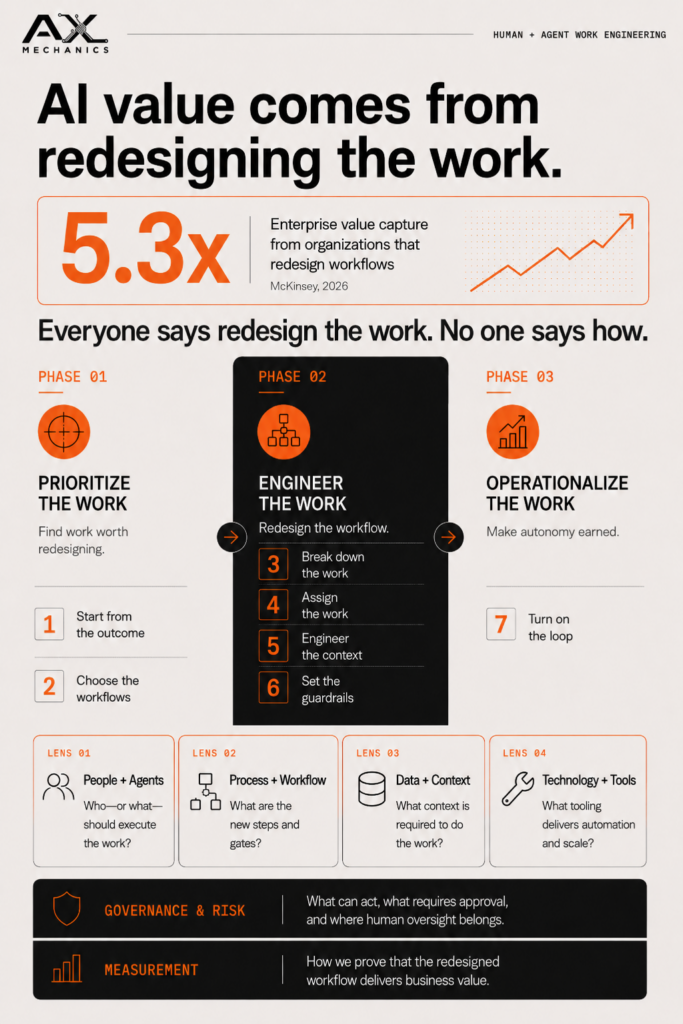
    McKinsey’s research gives us a pretty clear direction.  In a 2026 study of AI transformation readiness, leaders were 5.3× more likely to report enterprise value capture when workflows were redesigned than when they remained unchanged — 32% versus 6%. That said, IBM found that more than three-quarters of executives say most of their AI investment has gone toward improving existing processes. In contrast, 78% say capturing the maximum benefit from agentic AI requires a new operating model.

    We know the work needs to change.  But we keep investing in ways to make the old work faster.

    The technology still isn’t the hard part.

    I spent years leading the marketing technology stack at a large enterprise, and one truth kept repeating itself: the technology is rarely the hard part.  We could buy or build a genuinely useful business capability, get it through IT and security, integrate it into the stack, and still struggle to capture the value. The hard work was the same tough slog of digital transformation: executive alignment, cross-functional ownership, operating-model changes, team buy-in, process redesign, incentives, governance, and actually getting people to change how they work.  Technology can enable a different way of working.  It can’t make the organization operate differently.

    That hasn’t changed with AI.  If anything, AI is making the old transformation problems more visible.  Agents raise the stakes because they don’t just sit inside a tool waiting for someone to use them.  They can research, decide, create, update systems, trigger actions, and hand work to other agents.  Put that capability into a workflow with unclear ownership, contradicting approvals, bad handoffs, or missing context, and the agent inherits all of it — then starts executing it at scale.

    A method for engineering human-agent work

    The basic discipline isn’t new—it’s been around for a long time.  Business process reengineering showed us to start with the outcome, understand the work end to end, challenge the current process, and design a better one.  Agents add several elements the old playbooks didn’t have to answer in as much detail: which judgments should remain human, what context each actor needs at the moment of work, how much autonomy each part of the workflow gets, and what oversight needs to surround it?

    An AI-first redesign has to work across four connected dimensions.

    DimensionCore consideration
    People + AgentsWho — or what — should execute the work?
    Process + WorkflowWhat are the new steps and gates?
    Data + ContextWhat context is required to do the work?
    Technology + ToolsWhat tooling delivers automation and scale?

    Governance and risk span all four, defining what can act, what requires approval, and where human oversight belongs.  Measurement points back to the question that began the whole exercise: did the redesigned workflow deliver the business outcome we started with?

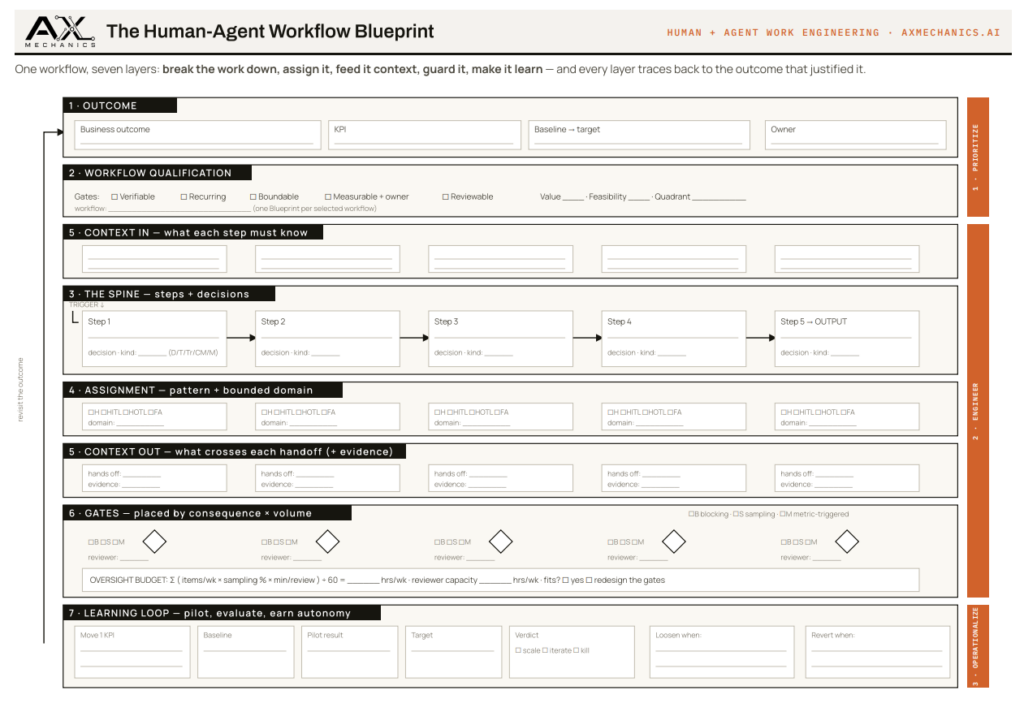
    We organize the approach into three phases and seven moves:

    • Phase One: Prioritize the Work
    • Phase Two: Engineer the Work
    • Phase Three: Operationalize the Work

    The quick version: break the work down, assign it, give it context, govern it, make it learn.

    Prioritize the Work

    1. Start from the outcome

    Start one level above the AI use case. Say the GTM outcome is faster, more consistent conversion of high-intent inbound demand.  One capability supporting that outcome is getting useful account intelligence into the hands of a seller quickly.

    Now we have recurring work to assess: Inbound lead → account research → account brief → xDR/AE handoff.

    That workflow might cross forms, first- and third-party enrichment, CRM and transaction history, website research, company research, prior engagement, custom account scoring, and some kind of seller notification.  It may cross marketing and sales ownership as well.  That’s enough surface area to redesign.

    2. Choose the workflows

    Not every process deserves an agentic workflow.  Before prioritizing one, we run it through five pass/fail gates:

    • Can the output be verified?
    • Does the work recur often enough to matter?
    • Can we put clear boundaries around what the agent can and cannot do?
    • Is there a measurable outcome with someone who owns it?
    • Can a human realistically review the work when review is required?

    A workflow can have enormous volume, high labor cost, and good technical feasibility, but none of those make up for a use case where errors can’t be detected, or nobody is accountable for the outcome.  A failed gate isn’t always rejection…it identifies the readiness work required to make the workflow eligible next time.  The answer might just be…‘later.’

    Assuming we make it this far, now we score what survives on two separate dimensions: value and feasibility.  High-value, high-feasibility workflows become the first transformation candidates.  High-value work with lower readiness may deserve a narrow experiment first, while work with low agent leverage may be a better candidate for conventional automation.

    Engineer the Work

    3. Break down the work

    Take the workflow apart far enough to see what each step actually requires. In the inbound example, gathering company information is different from deciding whether the account matters. Summarizing engagement history is different from deciding what the seller should do. Checking an account against ICP criteria is different from deciding the initial outreach channel.

    That matters when you start deciding what belongs with a person and what can move to an agent.  Some decisions are rules-based and don’t require human judgement or LLM reasoning at all: does this account match the ICP, is this signal recent enough, has the required account data been captured?  Others depend on direction, taste, trust, or business judgment. Those are different kinds of work, even if the current process has the same person doing all of them.

    Breaking the workflow down also creates an opportunity to question why the work is structured this way in the first place. Does every step still need to exist?   Can research that happens sequentially today happen in parallel?   Is a handoff there because the work requires it, or because two teams happen to own different parts of the process?  Does an approval address a real risk, or is it simply inherited from the way the organization has always worked?

    The goal is to redesign the work before deciding where (or if) AI fits.  Otherwise, it’s very easy to end up automating the same steps, handoffs, and approvals you already had.

    4. Assign the work

    Once the work is broken down, decide where each part belongs.  We use four assignment levels:

    Assignment levelDefinition
    HumanA person performs the work. Agents may support with research, drafting, or preparation, but the human is accountable for the task and the judgment.
    Human in the loopThe agent performs the work, but a human must review and approve it before anything consequential happens.
    Human on the loopThe agent completes the work within defined operating boundaries. Humans monitor and intervene when predefined triggers or exceptions occur.
    Fully agentThe agent executes autonomously within a bounded and observable domain, with metrics and reversion triggers providing oversight.

    In our inbound workflow, an agent might gather the research, build the brief, and write it to the CRM without approval, while the AE owns the interpretation and any customer outreach.  The agent’s operating domain might be explicit: named B2B accounts only, approved public and internal sources, no outbound contact, no pricing claims, no changes to opportunity stage.

    Those boundaries matter because autonomy is a critical design decision.

    5. Engineer the context

    A capable agent without the right context (or too much context) will still produce bad work.  The account-brief agent may need the company and domain, ICP criteria, CRM activity, known contacts, product interest, prior opportunities, approved research sources, and the questions the seller needs answered.  Write that down and treat it as a required input for that step.

    The output and handoff back needs the same approach. “Strong account, recommend follow-up” might be the way the agent scores the account.  But we’ve seen that without the evidence behind it, the seller may not trust it…what signals were found, where they came from, what is known, what remains uncertain, and why the agent reached its conclusion.

    6. Set the guardrails

    “Human in the loop” leaves a lot unanswered: where is the gate, what is the human evaluating, what happens when they reject the work, how quickly does review need to happen, and does every execution require it? The answer should follow risk and volume.  High-risk actions may need blocking approval. Work inside a well-understood process may be fine for ongoing human monitoring.  High-volume, lower-risk work may run independently unless a metric crosses a threshold.

    There’s a new tactic here: agent-assisted oversight. An independent, adversarial review agent can monitor the work, so human attention focuses on what it escalates and on a regularly scheduled audit of what it passes. This is how a workflow can move from human-in-the-loop to human-on-the-loop more quickly. Agent-assisted oversight can extend review capacity…but it doesn’t relocate accountability: a named human owner still owns the outcome.

    It should also be noted that there are really two types of governance: exercised governance, where you decide where the human gates go, and enforced governance, where the platform actually enforces them. A prompt can ask an agent to respect a given data policy…runtime controls and guardrails in the agentic platforms themselves make it impossible to cross. You need both: design defines the gates, and enforcement makes them real.

    Now calculate the oversight budget.  Suppose the new workflow produces 200 account briefs a month and proper review takes three minutes each. That consumes ten hours of human review.  If the owner has two hours available, the workflow design is already broken.

    Maybe every output gets reviewed during the pilot, and 10% get audited in production. Whatever the answer, do the math before the build, because human attention is one of the resources the workflow consumes.

    Operationalize the Work

    7. Turn on the loop

    Run the workflow on three accounts before you run it on 200.  Or even better, start with synthetic data and use an adversarial agent to review.  Look at where the agent had enough context and where it guessed or hallucinated, inspect the handoffs and evidence, and pay attention to what the human had to recreate or compensate for.  Then tighten the design and expand the scale and scope deliberately.

    Bring the workflow back to the business outcome you started with: did high-intent leads reach sellers faster?   Did conversion improve?  Did seller capacity increase?  Did cost fall?   Did quality improve?  Agent activity and business performance are different things. The redesigned workflow ultimately has to move the latter.

    What compounds

    A GTM organization may have dozens of important workflows, and nobody wants a two-month consulting exercise every time an agent enters one of them.  Done well, you don’t start over.  Each redesigned workflow leaves reusable features behind: shared context, reusable connectors, evaluation methods, approval patterns, governance controls, and a clearer model for where human judgment belongs.  The next workflow should start further along than the last one.

    Over time, those individual projects begin to add up to something more useful than a collection of AI implementations.  You start to build a repeatable way of deciding how work should be divided across people, agents, automation, and systems…and a common set of capabilities that make the next redesign faster and easier.  That’s how fifteen workflows become manageable without creating fifteen individual solutions.

    The models will keep changing, the tools will keep changing, and the work agents can perform will keep expanding.  The longer lasting capability is the organization’s ability to redesign the work as those capabilities evolve, while keeping business outcomes, human judgment, and accountability front and center.

    That is ultimately what turns AI from a series of experiments into a new way of operating that delivers compounding business value.

    The Human-Agent Workflow Blueprint

    Download The Blueprint

    What GTM Leaders are Asking

    What does it mean to redesign work around AI?

    It means starting with the business outcome and redesigning the workflow around the strengths of people, agents, automation, context, and systems. The goal is to decide which work should exist, who or what should perform it, what information is required at each step, where human judgment belongs, and how the workflow will be measured.

    Where should a GTM organization start with agentic AI?

    Start with a meaningful business outcome, then identify the recurring workflows that most directly influence it. The best first candidates are usually workflows with enough volume to matter, clear boundaries, measurable outcomes, and outputs that can be reviewed or verified. From there, prioritize based on value and feasibility.

    How do you decide what work should stay human and what should move to an agent?

    Break the workflow into smaller units and look at the kind of judgment each one requires. Direction, taste, trust, accountability, and high-consequence decisions often deserve human ownership. Criteria matching, research, synthesis, monitoring, and structured evaluation are often more delegable. The important distinction is the nature of the judgment, not whether the task looks difficult.

    What is the difference between human in the loop and human on the loop?

    Human in the loop means an agent performs the work but a person must review or approve it before anything consequential happens. Human on the loop means the agent operates within a defined boundary while people monitor performance, review samples, and intervene when specific triggers or exceptions occur.

    How much autonomy should an AI agent have in a GTM workflow?

    As much as the workflow can safely support. Autonomy should be designed around the consequence of errors, the ability to observe what the agent is doing, the ease of reversing mistakes, and the quality of the controls around the work. It should increase only as the workflow proves it can perform reliably.

    Why does context matter so much in agentic workflows?

    Agents can only make good decisions with the information available to them at the moment of work. That context may include account history, ICP criteria, product information, policies, brand guidance, customer signals, prior interactions, and approved sources. Good workflow design makes those requirements explicit rather than assuming the agent will somehow find what it needs.

    What does human oversight actually look like in an agentic workflow?

    It can take several forms. High-consequence work may require blocking approval before an action occurs. Higher-volume, lower-risk work may use sampling. Other work may run autonomously until a metric or exception threshold is crossed. The important part is to define the gate, the reviewer, the evidence they see, and the amount of human attention the design requires.

    How do you keep human oversight from becoming a bottleneck?

    Budget it before the workflow goes live. If 200 outputs require three minutes of review each, that creates ten hours of human work. If the owner only has two hours available, the design needs to change. The answer may be sampling, exception-based review, tighter operating boundaries, or moving lower-risk work to a more autonomous pattern.

    How should GTM leaders measure whether a redesigned workflow is working?

    Measure the business outcome, not just agent activity. Depending on the workflow, that could include pipeline conversion, cycle time, throughput, cost, seller capacity, quality, customer experience, or error rates. Agent-level measures still matter, but completing tasks successfully is not the same as creating business value.

    Do we need to redesign every GTM workflow from scratch?

    No. Each well-designed workflow should leave reusable assets behind: context objects, connectors, evaluation methods, governance patterns, approval logic, and operating boundaries. Over time, those shared capabilities make the next workflow easier to redesign and help the organization build a repeatable human-agent operating model.

    Sources:

    • McKinsey & Company, The State of AI in 2026: On the Road to ROI, August 25, 2026. Nearly nine in ten organizations report regular AI use; 37% report positive EBIT impact; eight in ten respondents report improved individual productivity. McKinsey source
    • McKinsey & Company, From Adoption to Impact: Three Horizons of AI Transformation, July 8, 2026. Organizations redesigning workflows were 5.3× more likely to report enterprise value capture than those leaving workflows unchanged (32% vs. 6%). McKinsey source
    • Deloitte, AI ROI: The Paradox of Rising Investment and Elusive Returns, October 22, 2025. Among organizations already using agentic AI, 10% reported significant ROI. Deloitte source
    • IBM Institute for Business Value, Agentic AI’s Strategic Ascent: Shifting Operations from Incremental Gains to Net-New Impact, 2025. Research on the operating-model changes required to capture value from agentic AI. IBM source
    • Accenture, Designing a New Agentic Collaborative Workforce, January 21, 2025. Accenture’s marketing redesign is expected to reduce average campaign steps from 135 to 85 and improve time to market by 25–35%. Accenture source
    • Michael Hammer, Reengineering Work: Don’t Automate, Obliterate, Harvard Business Review, July–August 1990. The classic process-reengineering argument for redesigning work rather than simply automating existing processes. Harvard Business Review source
  • Your Buyer Asked AI. What Did It Say About You? The Four Gates of AI Visibility.

    Your Buyer Asked AI. What Did It Say About You? The Four Gates of AI Visibility.

    For the last decade or more, managing online visibility was a consistent discipline.  A buyer searched, a search engine ranked pages, and marketing worked to make sure the right page appeared high enough to get the click.  AI changes more than just the interface. Increasingly, the machine is doing more of the buying work itself.

    Gartner found that 45% of B2B buyers used AI during a recent purchase.  In its 2025 buyer research, 6sense found that 95% of eventual winners were already on the buyer’s Day One shortlist.  That list increasingly comes from AI recommendations.  If buyers are handing research, comparison, and validation to AI—and early consideration largely determines who wins—then visibility is no longer just about whether a buyer can find your website.  It is increasingly about whether a machine can find enough credible evidence to understand your business, evaluate it against alternatives, and ultimately recommend it.

    That’s what we mean when we talk about AI Visibility:

    AI Visibility is the outcome of how AI systems discover, understand, evaluate, and ultimately recommend a business.

    Over the last several months, we’ve reviewed the academic research, commercial studies, and platform documentation on what actually influences whether a brand, product, or service is surfaced and recommended by AI systems.  We’ve distilled that evidence into a practical framework for improving AI Visibility—and found that many widely promoted “best practices” are either unsupported, ineffective, or sometimes actively harmful.  The result is a simpler question: what conditions actually matter, and where should you focus?

    AI has become a buying interface

    The easy interpretation is that this is another channel shift: buyers used to type a question into Google, now many of them type it into ChatGPT, Claude, or Perplexity.  The more consequential change is what happens after the question gets asked. Google has confirmed that AI Mode and AI Overviews may use query fan-out — issuing multiple related searches across subtopics and data sources to develop one response. Microsoft now exposes some of the corresponding grounding queries behind its own AI answers through Bing Webmaster Tools.

    So, a buyer asking for the “best enterprise platform for X” may actually trigger a much larger research exercise underneath the surface…which vendors serve enterprises, how the products compare, what they integrate with, what customers say, what the limitations are, and whether the online sentiment backs it up. 

    One prompt can become a research tree.  And instead of handing that research back to the buyer as ten blue links on a search engine result page, the machine synthesizes what it finds into an answer.  Microsoft describes grounding as the layer connecting the model to current, authoritative information beyond its training data — increasingly putting the agent, rather than the person, in the role of researcher.  That changes what it means to be visible.

    SEO is still the foundation

    SEO is not dead, and AI Visibility is not a replacement for it.  Google explicitly says its existing SEO fundamentals remain relevant to AI Overviews and AI Mode.  A page still has to be indexed and eligible for Google Search before it can appear as a supporting link, and Google says there are no special technical requirements beyond the normal Search foundation.

    But Google is no longer the only game in town.  Research indicates that ChatGPT grounds much of its search indexing on Bing.  Anthropic lists Brave Search as a web-search sub processor for Claude.  Perplexity—with its strong citation focus—runs its own search indexing.  OpenAI operates OAI-SearchBot specifically to surface websites in real-time ChatGPT search, while Anthropic documents separate search, user-triggered retrieval, and training crawlers.

    So traditional crawlability, indexation, relevance, authority, and useful content remain table stakes.  The mistake is assuming that it’s the whole game.  Once the machine is doing the reading, synthesizing, corroborating, and recommending, additional requirements come into play.  Can the relevant systems access the evidence?  Is the business present in the specific search indexes they consult?  Can the machine extract a useful answer once it finds content on owned channels like your website?  Does the wider evidence ecosystem reinforce or contradict what the business says about itself?

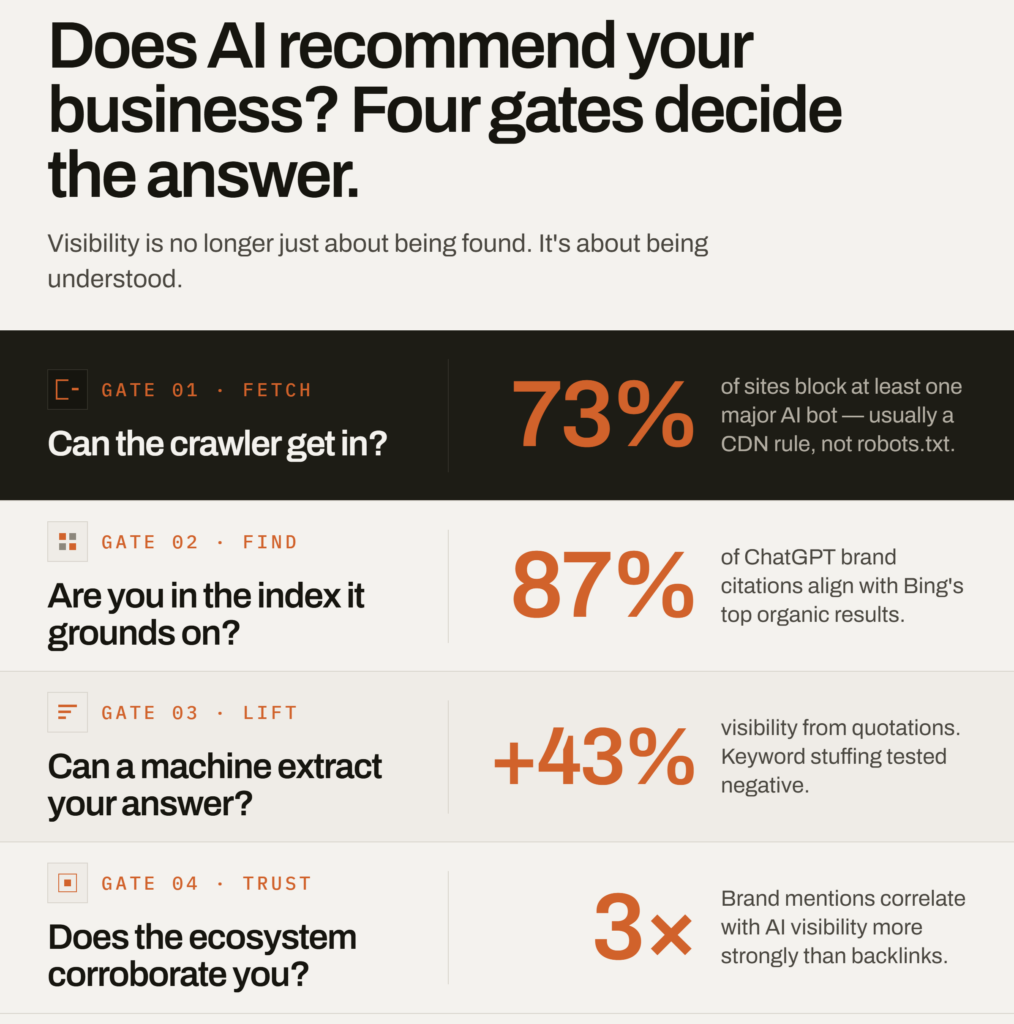
    Those requirements move beyond traditional SEO.  We organize them around four questions: Fetch, Find, Lift, and Trust.

    AI Visibility:  Four Gates

    FETCH — Can the machines even access your content?

    FETCH is the technical foundation of AI Visibility: can the systems you care about actually reach and read the information you want them to use?

    That sounds straightforward, but access is increasingly platform- and purpose-specific.  AI companies operate different crawlers for search, user-triggered retrieval, and model training.  OpenAI, for example, separates OAI-SearchBot from GPTBot.  Anthropic similarly distinguishes search, user, and training crawlers.  So “are we blocking AI?” is too basic a question.  A company may intentionally restrict model-training access while still wanting its content available to AI search, and the configuration needs to reflect that deliberate policy decision

    Robots.txt is only one layer. CDN and WAF policies can block or challenge crawlers even when robots rules allow them.  And JavaScript-heavy pages may expose different amounts of content depending on how a platform retrieves or renders the page.  The practical issue is not whether a site uses JavaScript or has bot protection.  It is whether decision-critical content is actually available to the AI systems and retrieval paths that matter.

    If FETCH fails, the rest of the optimization work on that evidence has little value. A machine cannot cite, quote, or verify from information it cannot reliably ‘see.’

    ProbeWhat it testsWhy it matters
    Per-bot crawler policyReads rules for search, user-directed, and training bots separately rather than reducing them to “AI allowed / blocked.”Search visibility and future training access are different decisions. Blocking one does not imply blocking the other.
    CDN / WAF interferenceLooks beyond robots.txt to identify challenge pages, bot-management rules, and the layer actually serving the response.A crawler can be allowed in robots.txt and still never receive the page.
    Raw-vs-rendered contentCompares meaningful content in raw HTML with the rendered DOM, weighted toward priority pages.JavaScript dependency is not automatically fatal, but it can reduce the depth and freshness available through some retrieval paths.
    Fetch latencyChecks whether important pages complete inside practical fetch windows rather than treating raw speed as a citation multiplier.Speed is best understood as a threshold: once the fetch fails, nothing downstream matters.
    Real-fetch validationWhere possible, validates the content received through the genuine platform retrieval path.It resolves the cases an external crawler simulation cannot and prevents good security from being mislabeled as a visibility failure.

    The point of FETCH is not to open every door to every bot.  It is to know which doors are open, to whom, and why.  Crawler policy has become a business decision.

    FIND — Are you present where the systems actually go looking?

    FIND is about retrieval coverage: when an AI system decides it needs outside information, are your pages and your brand present in the indexes and sources it searches?

    There is no single AI index.  Google’s AI experiences draw on Google Search.  Microsoft uses Bing as a grounding layer.  Other assistants rely on different retrieval environments and source mixes, which means strong visibility in one ecosystem does not guarantee visibility in another.

    That makes FIND less about “ranking in AI” and more about being present in the right search indexes and retrieval systems.  A company can be technically accessible and still disappear from an answer if the relevant pages are missing from the index an engine consults, poorly represented there, or absent from the third-party sources that surface for the question.  The practical implication is that index coverage has to be managed as an overall portfolio.  Google still matters enormously, but Bing and other indexes can create blind spots that conventional SEO programs may not be watching.

    And because some platform relationships are officially documented while others are reverse-engineered from observed behavior, FIND also requires that we optimize against what the evidence shows, and constantly retest and revalidate as the unseen, underlying architectures change over time.

    ProbeWhat it testsWhy it matters
    Google index coverageWhether priority pages are indexed and competitive in Google for the questions that matter.Classic SEO remains the entry ticket to Google’s AI features. Sometimes the “AI problem” is simply an SEO problem.
    Bing index coverageWhether important commercial pages are present and discoverable in Bing.Bing is an important AI grounding environment that many marketing teams have largely ignored for years.
    Secondary-index coverageChecks other relevant indexes where evidence supports a platform relationship.Different AI products expose different portions of the web. Coverage has to be managed as a portfolio.
    IndexNow / webmaster setupVerifies supported mechanisms for pushing updated content into an index and accessing first-party diagnostics.When freshness matters, passive rediscovery is unnecessary if the platform provides a push mechanism.
    Grounding-query analysisExamines the pages actually cited and the intermediate queries surfaced through Bing’s AI Performance report.It provides rare first-party evidence of what the retrieval layer actually searched for, rather than a simulation of what it might have searched for.

    If a buyer asks one question and the machine decides it needs six adjacent ‘fan-out’ searches before it can construct the answer, those grounding queries tell us something traditional keyword reporting never did: what evidence the machine decided it needed before it was willing to answer.  That leads directly to LIFT.

    LIFT — Can the machine turn what it finds into a usable answer?

    LIFT is about answerability: once an AI system finds your content, can it extract a clear, useful, well-supported answer from it, and is your own first-party content optimized for the machine to use it in the answer?  The system still has to identify the relevant passage, understand the claim, evaluate the supporting evidence, and combine it with other sources.  A page can rank well and still be poor source material if the answer is buried, ambiguous, unsupported, or trapped in a format that is difficult to extract.

    This is where content structure and evidence start to matter differently than they do in traditional search.  A Princeton-led GEO study found that changes to already-retrieved content could materially improve its visibility inside generated answers, with tactics such as quotations, statistics, and cited sources performing well in the experiment.  The important nuance is that this research speaks to selection after retrieval…it does not prove that adding those elements will cause a page to be discovered in the first place.

    LIFT is also about coverage.  Google’s query fan-out means one buyer question can expand into a cluster of related sub-questions.  A company may answer the headline question well but still lose the final response because it has weak or missing evidence on pricing, integrations, implementation, comparison points, or other parts of the buyer’s research tree.  This is also why it’s important to spend time researching real-world user questions and prompts, so you’re grounding your content strategy in the queries that real-world users (and their agents) are using.

    The practical implication is that content should be built not just to rank, but to be easy to extract and complete enough to support the full decision…direct answers, clear headings, high-performing formats mapped to query intent, credible evidence, and coverage of the questions buyers are actually asking.

    ProbeWhat it testsWhy it matters
    Answer extractionAttempts real buyer questions against priority pages using only retrievable content and logs why answers fail.Ranking does not guarantee answerability.  Missing, buried, ambiguous, or non-parseable information can disappear at the exact moment the machine needs it.
    Evidence-density auditIdentifies statistics, expert quotations, and cited sources and assesses whether they genuinely support the claim.Controlled research shows that usable evidence can improve visibility after retrieval.
    Heading–question mirroringCompares page headings with the way buyers actually phrase questions.“Our Solutions” tells the retriever little. “How does X integrate with Salesforce?” creates a much clearer target.
    Intent–format matchChecks whether the format matches the task: comparisons use tables, direct questions get direct answers, processes get explicit steps.Pre-structured evidence reduces the amount of reconstruction the machine has to perform.
    Fan-out coverageExpands priority prompts into likely sub-questions and maps each one to a strong, weak, or absent answer.You can win the head query and still get pruned from the final answer because important branches are uncovered.
    Substantive freshnessCompares the stated update date with what actually changed in the page.Maintaining current evidence is different from simply changing a timestamp.
    Over-optimization scanLooks for stuffing, artificial fragmentation, and inherited SEO behaviors that make content less usable.Generative systems reward usable evidence, not the appearance of optimization.

    There is a common thread through those probes: make less work for the machine. A comparison table is already a comparison.  A direct answer beneath a question-shaped heading is already an answer.  A statistic with a named source is already evidence.  The goal is not to write strange content for robots.  It is to reduce the cost of human…and machine…understanding. 

    TRUST — What does the rest of your ecosystem say about you?

    TRUST is about external validation: once an AI system finds information about your business, does the wider third-party ecosystem corroborate what you say about yourself?

    This is where AI Visibility moves furthest beyond the website.  AirOps found that 85% of commercial brand mentions in its study came from third-party domains, while Ahrefs found branded web mentions correlated much more strongly with AI Overview visibility than backlinks.  These are observational findings…not causal proof…but they point in the same direction.  AI systems build their understanding of a business from many sources, not just the business’s own site.

    Reviews, comparison sites, industry publications, communities, analysts, directories, partner sites, and visible experts all become part of that evidence.  If your website describes you one way but the rest of the ecosystem describes you differently…or barely mentions you at all…the machine has less reason to accept your version of the story.

    That makes TRUST less about traditional domain authority and more about corroboration and consistency across the sources AI systems actually rely on (not to say that domain authority isn’t still important).

    The practical question becomes: which sources are shaping AI answers in this category, are you present in them, and do they reinforce the position you want the market to understand?

    ProbeWhat it testsWhy it matters
    Citation-source mappingAggregates the publications, reviews, communities, reference pages, and other domains that repeatedly appear across category AI answers.Every market develops its own source diet. Authority strategy should begin with what the engines actually use, not a generic list of “AI-friendly” domains.
    Placement-gap analysisChecks whether the brand appears in those sources, how it is characterized, and where it appears in list/comparison formats.Presence is not necessarily binary. Being buried low in a comparison can behave very differently from being one of the options emphasized near the top.
    Review-platform footprintEvaluates presence, recency, volume, recurring sentiment, and response behavior on relevant review platforms.Reviews provide independent evidence of product experience…the evidence is much weaker for simplistic universal thresholds.
    Community presenceExamines real category discussions to see whether the brand appears, how it is described, and which competitors buyers recommend instead.First-person discussion provides evidence corporate content can’t manufacture. The right response is authentic participation, not spamming.
    Expert visibilityTests whether credible named people behind the company can be found through bios, quotes, bylines, credentials, and talks.Attributable expertise strengthens both the evidence itself and the earned-media ecosystem around it.
    Entity resolutionAttempts to resolve the business consistently across its site, major profiles, knowledge sources, directories, and databases.A system cannot confidently recommend an entity it cannot confidently identify.
    Boilerplate consistencyCompares how the company is described across owned and third-party properties.Repeated exposure builds machine understanding; repeated contradictions build ambiguity.
    Brand-mention footprintMeasures the scale, quality, and trajectory of third-party discussion relative to competitors.It measures an input into AI understanding, rather than an outcome produced in an AI answer.

    TRUST is ultimately about making sure the public evidence around your business tells a clear, credible, consistent story.  Your website is still your most controllable source of truth. It just isn’t the only (or even most important) one.

    Parametric vs. Grounded — Two paths, two clocks

    AI answers draw on two sources.  Parametric memory is what the model learned during training—brand strength, category associations, and general knowledge.  Grounded retrieval is what the system searches and reads at answer time—current facts, detailed evidence, and citations.  The two work together.  Even when an answer is grounded, the model arrives with an existing view of the category that influences which brands come to mind and how the question gets framed. Then retrieval supplies the current evidence.

    Parametric memory picks the cast…grounded retrieval supplies the script.

    TRUST is the important overlap.  A strong third-party article can influence a grounded answer as soon as it is retrieved, while also becoming part of the broader set of content that may train future models.  That is why AI Visibility programs need to work on both clocks at once: the fast clock improves the evidence available now…the slow clock builds the market presence models learn over time.

    And no, you do not “rank #3 in ChatGPT”

    The emerging AEO industry has borrowed a mental model from SEO that doesn’t work for LLMs: the idea that there is a stable position in AI Visibility that you can report on.  There isn’t.  AI answers are stochastic, so there is no stable “position” equivalent to a search ranking.  SparkToro and Gumshoe ran 2,961 repeated recommendation tests and found that identical prompts produced the exact same brand list less than 1% of the time.

    LLM output is indeterminate.  That doesn’t mean that AI Visibility is unmeasurable.  It means that—similarly to political polling or brand impact metrics—it has to be measured through repeated sampling rather than a single observation.  The useful question is not “What rank are we in ChatGPT?” but “How often do we appear across the buyer questions that matter, relative to competitors…and is that rate changing beyond normal variation?”

    It also helps to separate two outcomes. Mention Rate measures how often the brand appears in answers. Citation Rate measures how often brand-owned content is cited as evidence. Tracking the two separately gives a much clearer picture than collapsing everything into a single “AI score.”

    AI Visibility is measurable.  It just isn’t measurable like a SERP.

    Measure the outcome. Diagnose the causes.

    AI answers vary.  The conditions behind them are much easier to diagnose.  A crawler is allowed or blocked.  A page is indexed or it is not.  The content clearly answers the buyer’s question or it doesn’t.  The sources shaping the category include your business…or they don’t.  Other questions require judgment, but they can still be evaluated against evidence rather than treated as guesswork.

    That is why outcome measurement and diagnosis are different jobs. The outcome tells you whether you are appearing. The diagnosis helps explain why.  A visibility metric tells you how you are showing up. A diagnostic tells you what you can influence and change.

    AI Visibility is a system to manage

    The more we study this space, the less AI Visibility looks like a collection of tactics for getting cited by ChatGPT.  SEO matters.  Technical access matters.  Content structure matters.  Third-party evidence, entity clarity, and measurement matter.  What connects them is the machine doing more of the evaluation.  That is why AI Visibility is not a new ranking to chase. It’s a system to manage over time.

    Today, the immediate question is whether AI systems can find, understand, trust, and recommend your business.  As agents begin comparing options, interacting with systems, and taking actions on a buyer’s behalf, the question will become bigger: what happens when the agent actually tries to evaluate and do business with you?  That is the emerging territory of Agent Experience (AX)…more to come on that in a future post.

    The web was designed around humans finding information.  AI systems are increasingly deciding which evidence makes the answer…and which businesses make the shortlist.  Marketing now has two audiences to design for: the human buyer and the agent increasingly helping that buyer discover, evaluate, and act.

    Questions Marketing Leaders Are Asking

    What is AI Visibility?

    AI Visibility is the outcome of how AI systems discover, understand, evaluate, and ultimately recommend a business. It is broader than whether a company appears in search results. A business also needs to be accessible to relevant AI systems, present in the sources and indexes they use, easy for those systems to understand, and supported by credible evidence across the wider web.

    Why does AI Visibility matter for B2B companies?

    B2B buyers are increasingly using AI to research vendors, compare alternatives, gather product information, and validate decisions. That means an AI system may help determine which companies make the buyer’s consideration set before the buyer ever visits a website or speaks with sales. For companies competing in considered-purchase categories, being accurately understood and represented by AI is becoming part of being considered at all.

    Why is AI Visibility especially important for challenger brands?

    Challenger brands often need to earn consideration against competitors with greater awareness and market presence. When a buyer asks questions such as “What are the best alternatives to X?”, “X versus Y,” or “Which platform is best for my company?”, AI systems are helping construct the shortlist. A challenger that is absent, poorly understood, or weakly supported by evidence can lose before the buyer ever reaches its website.

    How is AI Visibility different from SEO?

    SEO helps search engines crawl, index, understand, and rank web pages, and those fundamentals remain essential to AI Visibility. But AI systems often go further: they retrieve information from multiple search environments and sources, extract specific evidence, compare claims, synthesize what they find, and construct an answer. AI Visibility therefore includes SEO, but also considers retrieval coverage, answerability, third-party corroboration, entity clarity, and how consistently the market describes the business.

    What are the four gates of AI Visibility?

    The four gates are Fetch, Find, Lift, and Trust. Fetch asks whether AI systems can access the evidence. Find asks whether the business and its content are present in the indexes and sources those systems search. Lift asks whether the information can be easily extracted and used in an answer. Trust asks whether credible third-party evidence reinforces what the business says about itself. Together, the four gates provide a way to diagnose why a company is—or is not—appearing in AI-generated answers.

    Why might my company rank well in Google but still be missing from AI answers?

    Strong Google rankings do not guarantee strong AI Visibility. Different AI products may use different retrieval environments, search indexes, grounding queries, and third-party sources. Your content may also be discoverable but difficult to extract, incomplete for the buyer’s question, or contradicted by other evidence. A company can therefore perform well in traditional search while still having gaps across Fetch, Find, Lift, or Trust.

    What makes website content more likely to be used in an AI answer?

    Content is easier for AI systems to use when it directly answers the buyer’s question, uses descriptive headings, presents comparisons and processes in structured formats, and supports important claims with credible evidence. A comparison table is already structured as a comparison; a direct answer beneath a question-shaped heading is already structured as an answer. The objective is not to write artificially for AI, but to reduce the work required for both people and machines to understand the information.

    What content should a B2B company create for AI-driven buyer research?

    Start with the questions buyers actually ask while evaluating a category: alternatives, comparisons, integrations, implementation requirements, use cases, limitations, pricing considerations, customer fit, and evidence of results. Then make sure those questions have clear, substantive answers on your site and are supported by credible evidence elsewhere. AI systems may expand one buyer prompt into multiple related searches, so strong coverage of the entire decision tree matters more than optimizing a single page for a single query.

    Can you measure whether a brand ranks in ChatGPT or other AI answer engines?

    Not as a stable position like a traditional search ranking. AI answers vary across repeated runs, so a single prompt response creates false precision. A better approach is repeated sampling across the buyer questions that matter and measuring outcomes such as how often the brand appears, how often its content is cited, how it compares with competitors, and whether those rates change beyond normal variation.

    Where should a B2B marketing team start improving AI Visibility?

    Start with the buyer questions that matter most to revenue, particularly the questions prospects ask when comparing vendors and making a shortlist. Test how the business appears across relevant AI systems, then diagnose the causes through Fetch, Find, Lift, and Trust. Fix foundational access and retrieval problems first, strengthen weak or missing answers, and build credible external corroboration where the evidence ecosystem is thin. Measure the resulting visibility through repeated sampling rather than one-off prompts.

    Sources

    • Gartner, “Gartner Survey Finds 69% of B2B Buyers Turn to Sales Reps to Validate AI-Generated Insights,” May 2026 — survey of 645 B2B buyers; 45% reported using GenAI during a recent purchase, primarily to gather vendor and product information.
    • 6sense, 2025 B2B Buyer Experience Report — nearly 4,000 buyer journeys; the eventual winning vendor was on the buyer’s Day One shortlist 95% of the time.
    • Google Search Central, “AI Features and Your Website” and “Optimizing for Generative AI Features” — official guidance confirming query fan-out, continued relevance of foundational SEO, Search-index eligibility, and Google’s guidance for AI Overviews and AI Mode.
    • Microsoft Bing, “Elevating the Role of Grounding on the AI Web,” February 2026 — defines grounding as the connection between AI and current information beyond model training, and describes agents increasingly acting as retrievers.
    • Microsoft Bing, “Introducing AI Performance in Bing Webmaster Tools,” February 2026 — documents URL-level AI citations and grounding-query phrases, providing first-party visibility into part of the retrieval process.
    • Microsoft Bing, “New AI Visibility Insights in Bing Webmaster Tools,” June 2026 — expands grounding-query reporting with intent, topic and citation-share data.
    • OpenAI, “Overview of OpenAI Crawlers” — official documentation distinguishing OAI-SearchBot, GPTBot and ChatGPT-User, including the separation between search visibility, user-directed retrieval and model-training controls.
    • Anthropic, “Does Anthropic Crawl Data From the Web?” — official documentation distinguishing Claude-SearchBot, Claude-User and ClaudeBot for search, user-directed retrieval and model development.
    • Anthropic, Subprocessors — lists Brave Search among Anthropic’s subprocessors.
    • Perplexity, “Perplexity Crawlers” and Perplexity Search Research — documents PerplexityBot as its search crawler and describes Perplexity’s own large-scale web indexing infrastructure.
    • Google Search Central, “JavaScript SEO Basics” — documents Google’s crawl → render → index process and supports the nuance that JavaScript is not simply “invisible,” while retrieval capabilities differ by crawler and system.
    • Seer Interactive, “87% of SearchGPT Citations Match Bing’s Top Results,” February 2025 — independent study finding strong historical alignment between SearchGPT citations and Bing organic results. This is observational evidence, not confirmation of OpenAI’s underlying architecture.
    • Aggarwal et al., “GEO: Generative Engine Optimization,” KDD 2024 — 10,000-query controlled benchmark showing that changes to already-retrieved content can improve visibility in generated answers by up to approximately 40%, with effectiveness varying by domain.
    • AirOps, “Third-Party Sources Drive 85% of Brand Discovery,” October 2025 — analysis of more than 21,000 commercial brand mentions; 85% came from external domains versus 13.2% from brands’ own domains. Vendor research; best treated as directional rather than causal.
    • Ahrefs, AI Visibility research across 75,000 brands — branded web mentions showed substantially stronger correlation with AI visibility than backlinks; Ahrefs explicitly cautions that correlation does not establish causation.
    • SparkToro / Gumshoe, “AIs Are Highly Inconsistent When Recommending Brands or Products,” January 2026 — 2,961 repeated tests; identical recommendation lists appeared fewer than 1 in 100 times, with identical ordering rarer still.
    • Schulte, Bleeker & Kaufmann, “Don’t Measure Once: Measuring Visibility in AI Search (GEO),” 2026 — finds that AI visibility varies across runs, prompts and time and argues for repeated measurement and distribution-based reporting rather than one-off observations.
    • Sielinski, “Quantifying Uncertainty in AI Visibility,” 2026 — statistical analysis showing that single-run citation visibility can imply false precision and that many apparent differences fall within the measurement noise floor.
  • One Disruption, Two Fronts: Agents Have Joined Your Marketing Team, and Your Buyer Brought One Too

    One Disruption, Two Fronts: Agents Have Joined Your Marketing Team, and Your Buyer Brought One Too

    AI has disrupted B2B marketing from two directions simultaneously—agents are beginning to do marketing’s work inside of the organization and agents are entering the buyer journey outside of it. Most of the commentary you’ll read treats these separately. One is an efficiency story—AI tools help marketers produce more, faster. The other is a channel story: AI search is the new SEO, and you need to go and optimize for it. Treated separately, each gets a separate response—productivity tools for the first, an AEO/GEO visibility project for the second. Treated together, they describe something much bigger—B2B marketing’s operational requirements have changed both on the supply side and on the demand side at the same time. And to win in this new environment, marketing organizations need to master both.

    The Inside Front: Agents Join the Work

    Inside our marketing organizations, AI has crossed over from experimentation to labor. And adoption is only accelerating. Salesforce’s State of Marketing—a survey of 4,450 marketers across 26 countries—shows three-quarters of marketing organizations now using AI, with 13% already running agentic AI. HubSpot adds that 61% of marketers say marketing is experiencing its biggest disruption in twenty years.


    Agents today proactively research accounts and assemble briefing documents. They draft and iterate content against a brand’s codified voice and tone—reviewing and iterating on each other’s work. They score and re-score leads as new account and persona-level buyer signals arrive. They execute campaign operations that used to take up a MOPs manager’s whole week: list pulls, QA checks, lead enrichment, UTM hygiene. They analyze performance, summarize in plain language, and propose the next set of tests. Not perfectly, and not unsupervised—but as actual working additions to the team.


    The significance isn’t that marketing tasks got faster and cheaper. It’s that the structure of the work itself is changing. A marketer with agents isn’t just a faster marketer…they’re the director of a team of agents that can sense, reason, act, and learn at a level that used to be limited by scarce resources. The account research that was reserved for the top ten logos, the tradeshow leads that died in a spreadsheet, the messaging that never got adapted for the other twelve industries you sell into—the work that used to fall below the line can now finally be done. That loop—sense, reason, act, learn—is the foundation everything else gets built on.

    The Outside Front: Your Buyer Brought an Agent

    Outside the building, AI has become a buying interface. B2B buyers are moving the tough work of buying—research, comparison, RFPs, validation—into AI conversations that you don’t control and mostly can’t see. The knee-jerk is to see this as a search behavior shift: people now ask ChatGPT instead of Google. But the data shows that the shift is deeper than that. 6sense found buyers using LLMs not mainly at the top of the funnel but in the middle of it…comparing offerings side-by-side, synthesizing vendor documentation, modeling costs, drafting RFPs. That isn’t search—that’s the evaluation work that used to include MOPs and martech managers grilling vendors, doing analysis, speaking with peers, and consulting with analysts…handed over to the machine.


    And when AI-assisted buyers do finally click over to your owned channels, they arrive different. Adobe’s analysis of AI-referred traffic found those visitors converting 42% better, generating 37% more revenue per visit, and spending 48% longer on site than conventional traffic (that’s retail data, so treat it as directional for B2B…but the behavioral implication still applies). By the time an AI-referred visitor lands, the agent has already done the researching, comparing, and a good share of the deciding.


    Two more data points bring focus. Gartner reports that 67% of B2B buyers now prefer a rep-free buying experience. And yet, 69% of buyers turn to sales reps specifically to validate AI-generated insights. Read together, you start to see the new journey. The machine does the gathering and the recommending, and the human moments that remain are the trust moments that matter. Fewer touches—with each one carrying more weight. If that sounds like an argument that human relationships matter more in an AI-assisted market—it is.


    This front is maturing into something B2B has never had to deal with: the buyer’s agent as a first-class audience—models that discover you, evaluate you, compare you, and increasingly transact with you on their human’s behalf. For now, the point is simpler: influence is forming in places your funnel can’t see…before your funnel even begins.

    Why “a copilot rollout and some pilots” isn’t an answer

    Faced with all this, most organizations have responded with the standard playbook: license a copilot for the team, encourage AI adoption, spin up a handful of pilots, appoint an AI council, and wait for the productivity to show up in the numbers.


    It mostly hasn’t. MIT’s widely discussed 2025 study of enterprise AI initiatives found that about 95% of generative AI pilots produced no measurable P&L impact. Some 40% of organizations had deployed AI tools, but only around 5% had integrated them into workflows at scale. I’d treat “95%” as directional rather than truth…but the direction matches what McKinsey’s State of AI research has found two years running: the value goes to organizations that redesigned the work, not the ones that distributed tools.


    That pattern isn’t a technology failure—it’s a conditions failure. For the loop to function at scale—agents sensing, reasoning, acting, and learning on real work, with humans directing and validating—both the agents and the people need things most organizations haven’t yet built: coherent context, connected tools, content machines can use, clear decision rights, and measurement fast enough to learn from. Deploy tools without those conditions and you get exactly what the studies describe: high adoption and low transformation.


    None of this means boiling the ocean before you start—there are real early wins available. But it does mean choosing wins that start building the conditions rather than postponing them.

    The Volume Trap

    When AI made content production essentially free, the obvious move was to produce more: more posts, more emails, more sequences, more channels. It’s the path of least resistance because it uses the new capability to run the old strategy harder. And activity felt like adoption and progress.


    When content was expensive, volume was a signal—a company producing a lot of collateral probably employed people who understood the problem. Now that most new content involves AI, volume signals nothing. Every obviously templated “personalized” touch spends a little of something B2B can’t run without…your buyer’s belief that a person who understands their problem is behind what your company says. And the noise fails with the new audience too…an AI model assembling an answer about your category compares your claims against everything else it can find—and cited quality gets filtered up, not volume.


    Free content, it turns out, can be the most expensive kind.

    Buyer Enablement Finally Gets an Execution Engine

    So far, we’ve viewed this through the lens of the B2B marketer facing the most disruptive technology to impact our discipline in decades. But we mustn’t forget our most important audience and outcome—building enduring relationships with our most important customers based on trust. For years, Gartner has characterized B2B buying as a tough slog. And as someone who sat in the martech buyer’s chair for years, I can attest that wrangling requirements, vendors, budgets, committees, IT, and procurement isn’t exactly retail therapy.


    Gartner’s research describes six “jobs” every buying group has to complete—identifying the problem, exploring solutions, building requirements, selecting suppliers, validating the choice, and building consensus among the six to ten stakeholders who each own a piece of the decision. The jobs don’t run in sequence…buying groups loop through them, revisit them, and stall inside them. Gartner’s prescription was buyer enablement: the suppliers who win are the ones who make the buying jobs easier.


    Here’s what’s new: buyer enablement finally got an execution engine. The agents inside your organization can produce enablement at a depth that was never economical before—the content that actually addresses a requirement, the timing that matches needs in the moment, the depth on the accounts that matter. And the agents your buyers bring are consuming enablement on the buyer’s behalf—running the exploration, requirements, and comparison jobs at machine speed, while the humans keep the jobs machines can’t do: validation and consensus—the trust jobs.


    Both fronts, one customer outcome: buying gets easier. Everything we build is in service of that.

    Where This Goes

    So…two fronts, one transformation. The inside front asks you to rebuild how marketing’s work gets done around a workforce of humans and agents. The outside front asks you to rebuild how your company is discovered, understood, and evaluated for a buying journey that increasingly includes machine audiences. And the answer to both runs through the same foundation, which is why a tool rollout can’t get you there and a real blueprint can. The destination is an agent-ready marketing organization—one built to run both fronts as a single program, on a single foundation.

    So the question worth taking into your next planning cycle isn’t “are we using AI?” It’s “are we building the conditions, or just distributing the tools?”

    Questions Marketing Leaders Are Asking

    How is AI changing B2B marketing?

    AI is changing B2B marketing on two fronts at once. Inside the organization, AI agents are beginning to perform work such as research, content development, campaign operations, lead analysis and optimization. Outside the organization, buyers are increasingly using AI to research, compare and evaluate vendors before interacting with sales. Marketing organizations therefore need to redesign both how work gets done and how their companies are discovered and evaluated by AI.

    What is an agent-ready marketing organization?

    An agent-ready marketing organization is designed for humans and AI agents to work together rather than simply giving employees AI tools. It provides agents with the context, data, content, systems access, decision rights and measurement they need to perform useful work, while defining where humans direct, approve, evaluate or intervene.

    Why don’t AI copilots and isolated AI pilots create more marketing value?

    AI tools improve individual productivity, but measurable business value usually requires changes to the underlying workflow. If an agent cannot access the right context, interact with the systems where work happens, understand its decision boundaries or learn from outcomes, it remains an isolated assistant rather than part of an operating system for getting work done. The objective should be workflow transformation, not simply tool adoption.

    Where should a B2B marketing leader start with AI agents?

    Start with a meaningful business outcome and identify the workflow that produces it. Then break the workflow into work that should remain human, work an agent can perform with human approval, work that can operate with human oversight, and work that can safely be fully automated. Early implementations should create measurable value while also building reusable capabilities such as context, orchestration, governance and measurement.

    How are AI agents changing the B2B buyer journey?

    AI is increasingly performing parts of the B2B buying process that buyers previously handled themselves: researching a category, comparing vendors, synthesizing documentation, developing requirements and validating alternatives. That means influence can form before a prospect visits a vendor’s website or speaks with sales. When a human interaction finally occurs, it is increasingly a validation and trust moment rather than the beginning of discovery.

    Why does AI visibility matter especially for B2B challenger brands?

    Challenger brands often depend on being considered alongside better-known competitors during evaluation. If buyers ask AI systems questions such as “best platforms for X,” “X versus Y,” or “alternatives to X,” the AI system becomes part of the consideration process. A challenger that is poorly understood, weakly supported or absent from those answers can lose consideration before the buyer ever reaches its website.

    Is AI visibility just another form of SEO?

    No. SEO helps search engines discover and rank web pages, and it remains an important foundation. AI visibility is broader: it concerns whether AI systems can discover, understand, evaluate and confidently represent a company when answering a buyer’s question. That can depend on owned content, search indexes, machine-readable information, third-party sources, brand authority and the consistency of evidence about the business.

    How should B2B companies prepare for buyers using AI to compare vendors?

    Companies should make it easy for both humans and machines to understand what they sell, who it is for, how it differs from alternatives and what evidence supports their claims. That includes clear comparison and use-case content, accessible product information, consistent company and product descriptions, credible expert perspectives, customer evidence and corroboration from trusted third-party sources. The goal is not to manipulate an AI answer; it is to make the business easier to accurately understand and evaluate.

    What should a B2B agency do when clients start asking about AEO, GEO or AI visibility?

    Start by determining what clients actually need to know: whether AI systems can access their content, whether the brand appears during relevant buyer questions, how accurately the business is represented, what sources AI systems rely on, and what prevents stronger visibility. Treating AI visibility as a measurable diagnostic problem is more useful than immediately selling a checklist of new optimization tactics.

    Do agencies need to build their own AI visibility practice to help clients?

    Not necessarily. Agencies can build the capability internally, partner with a specialist, or combine their existing expertise in demand generation, content, SEO or brand with specialist AI visibility diagnostics and engineering. The right model depends on client demand, existing technical capabilities and whether building a dedicated practice creates enough differentiation to justify the investment.

    Should marketing organizations focus first on AI agents inside the company or AI visibility outside it?

    They should treat them as two parts of the same transformation, but they do not have to implement everything simultaneously. The best starting point is usually the business problem with the clearest value: redesign a high-impact internal workflow around humans and agents, address a material gap in how AI systems represent the business to buyers, or do both in parallel when the conditions allow. Over time, both fronts depend on many of the same foundations—usable context, connected systems, machine-readable content, governance and measurement.

    Sources