Sometimes the right answer is an agent. Sometimes it’s a workflow with an agent inside it. Sometimes it’s straightforward automation. We determine which before we build anything.
A production systemWorks repeatedly, inside your business.
Getting a model to perform a task once is relatively easy. The harder work is building a system that can perform the job reliably inside your business. That requires clear decisions about:
01What the model should judge
02What deterministic automation should handle
03Which systems it can read from and write to
04Where people approve, review or intervene
05How quality will be evaluated
06What happens when the system is uncertain or something fails
Production requires more than intelligence. It requires engineered context, controls, connections and ownership.
Turn your business outcome into a system that can be built.
The Agent Scoping Sprint
We start with the job you want an agent to perform, then work backward from the outcome. The sprint resolves four questions that have to be answered before development begins. The agent scoping sprint is completed rapidly and makes sure we’re aligned on the outcome.
The outcomeWhat outcome should the system produce—and what is explicitly outside its scope?
The workWhich steps require model judgment, deterministic automation or a person?
The connectionsWhat context, data and business systems must the system read from or write to?
The controlsHow will actions be constrained, quality evaluated and uncertainty escalated?
You leave with
The Agent Spec
An agile, build-ready specification for the production system: its job, workflow, human checkpoints, system access, tool permissions, evaluation plan, architecture, success measures and build scope.
Sometimes the resulting system is an agent. Sometimes it’s a workflow with agents inside it. Sometimes it’s simpler automation. The sprint makes that decision before development begins.
From a named use case to a production system.
Scope → Build → Run
01
Scope
Determine whether the job requires an agent, an agentic workflow or automation—and specify how it should work.
Output
A build-ready Agent Spec and defined production scope.
→
02
Build
Deploy the system in your environment with the required integrations, context, evaluations, controls and human checkpoints.
Output
A working production system, evaluation harness, operational controls and runbook.
→
03
Run
Monitor quality, cost, adoption and failures. Test model upgrades and improve the system as the work and technology change.
Output
Ongoing evaluation, monitoring, upgrade reviews and a prioritized improvement backlog.
Production agents and workflows built for real work.
Our work
These examples show how model judgment, deterministic automation and human decision-making can be combined into reliable production systems.
Gage — AI presales agent
Talk to it. It’s on this page.
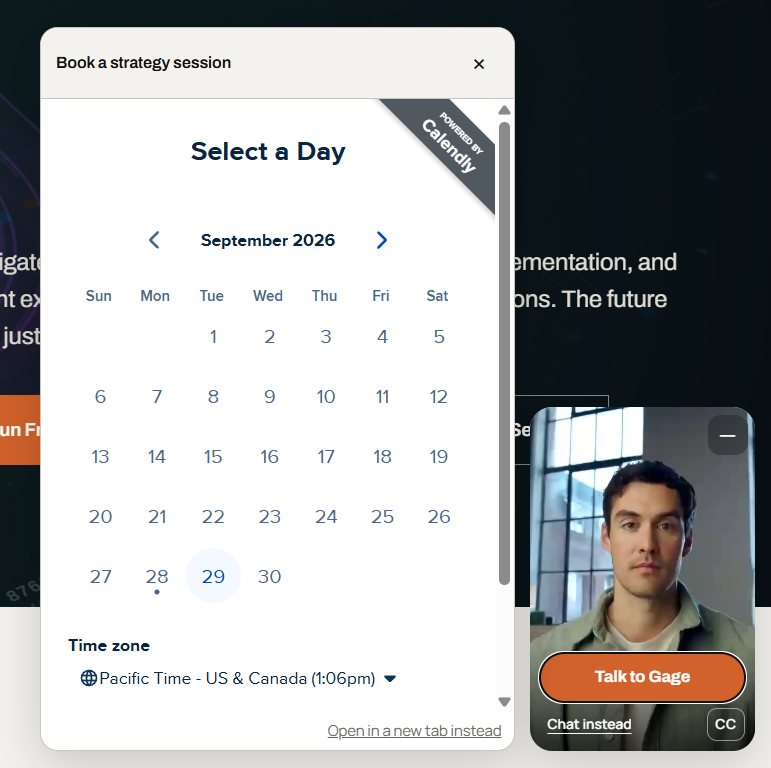
Gage holds a real conversation by text or voice, understands what a visitor is trying to solve, answers questions about product and solution offerings, qualifies prospects, runs an AI visibility scan, books a strategy session on the calendar and updates the CRM.
What it demonstrates
Discovery before recommendation
Text and voice in the same conversation
Real actions across scanning, scheduling and CRM systems
Tool-level controls and tested conduct
A useful next step instead of a form
Client application
Presales, inbound qualification, meeting booking and intelligent website experiences.
One assistant for the everyday work of running a family.
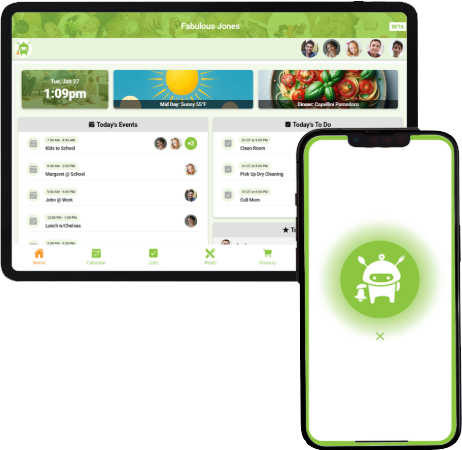
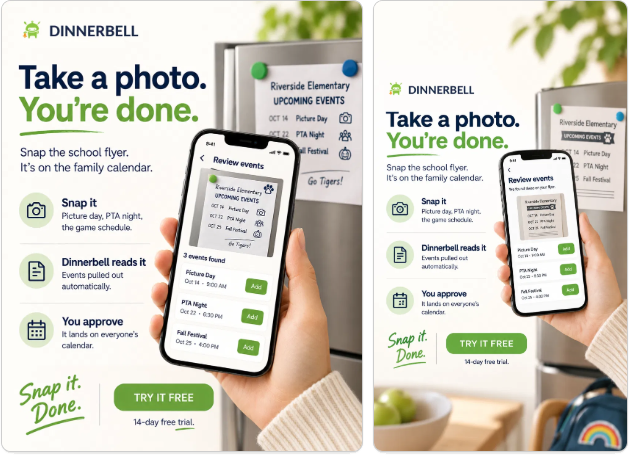
Dinnerbell helps families manage calendars, meals, lists and everyday coordination through text, email, voice and the app. It understands photos, documents and forwarded messages, works with live family information, and can complete requests that cross multiple tasks and systems.
What it demonstrates
One continuous experience across text, email, voice and app
Understanding of messages, photos, documents and screenshots
Coordinated action across calendars, lists, meals and reminders
Current information read directly from the systems that own it
Clear confirmation of what was completed, what was not and what needs attention
A model for customer-service and account-assistant experiences that need to understand different inputs, work across systems and complete real tasks reliably.
AI-First Prospecting Engine
From the right account to relevant outreach—grounded in a real finding.
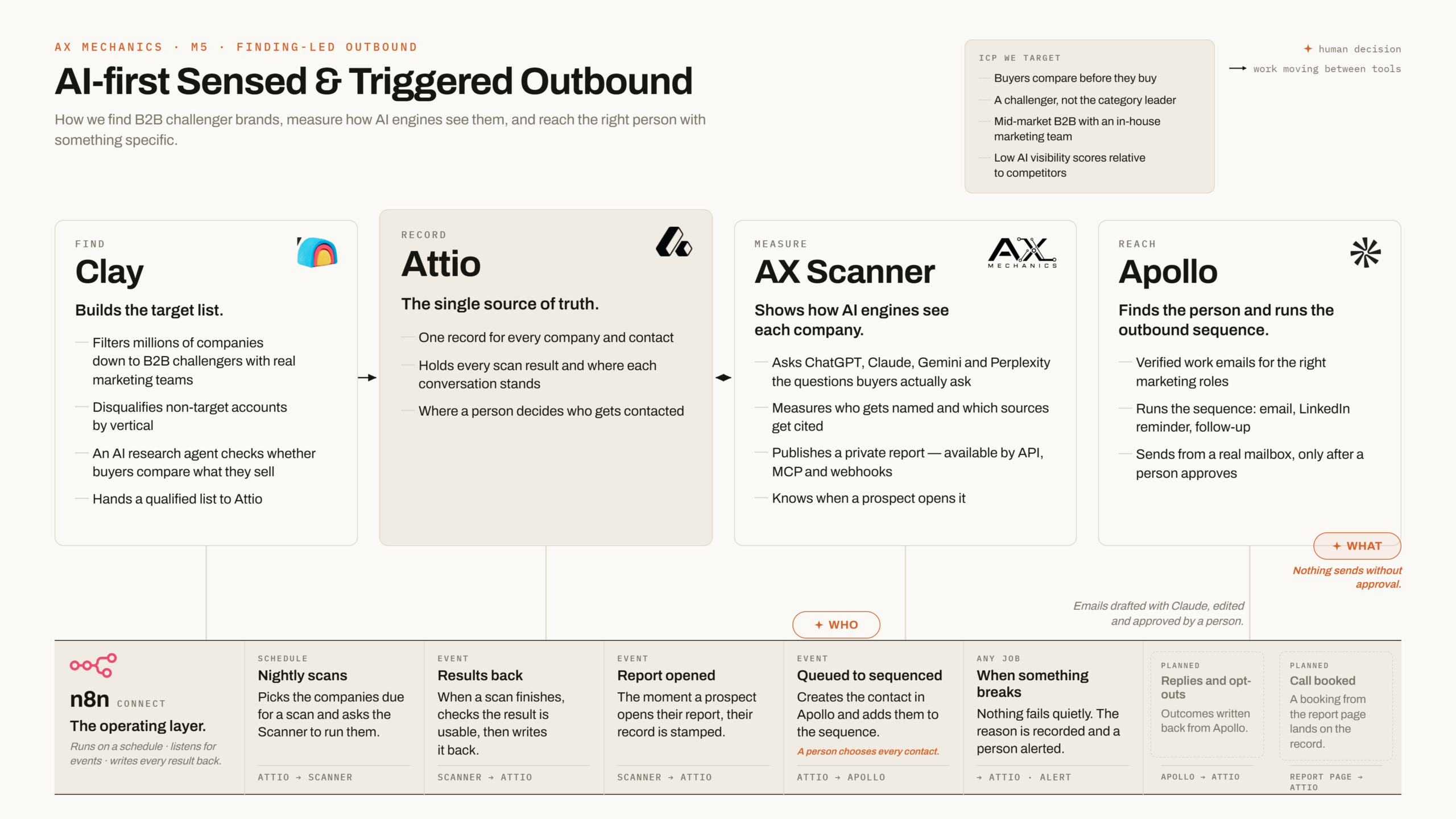
A connected outbound workflow that uses Clay to find and score target companies, the AX AI Visibility Scanner to uncover a reason to engage, Attio to hold the account context, and Apollo to run approved email and LinkedIn sequences. n8n orchestrates the work across the system.
What it demonstrates
Claygents for account research, AI triggers and custom scoring
AI interpretation of each company’s AEO and AI-visibility results
AI-generated email and LinkedIn content grounded in those findings
Attio CRM maintaining the account, contact and outreach context
Apollo Sequences and n8n moving qualified prospects into action
Client application
AI-first outbound prospecting that helps GTM teams identify better-fit accounts, find a credible reason to engage and create outreach that is specific to each prospect.
A person approves who gets contacted and what gets sent.
Meta Creative Refresh Agent
From performance signals to fresh, on-brand creative—ready for approval.
The agent reads live Meta performance, identifies creative fatigue, proposes new themes with evidence, generates on-brand ads and stages the approved creative in Meta as paused. People select the concepts and approve the finished work before anything enters the ad account.
What it demonstrates
Live analysis of campaigns, ads, performance and creative-fatigue signals
New themes and copy supported by performance data, timing or cited sources
On-brand creative generated from a machine-readable brand system
Automated checks for format, policy, brand consistency and unsupported claims
Two human approvals and tightly controlled access: the agent can stage ads, but never launch them or change budget or targeting
Client application
A supervised creative-production agent that helps paid-media teams move from performance insight to refreshed, platform-ready advertising—without giving up control of the brand or media spend.
The agent reads, recommends, creates and stages. A person decides what moves forward.
AX Scout — the agentic AEO mystery shopper
See your business through the eyes of an AI buyer.
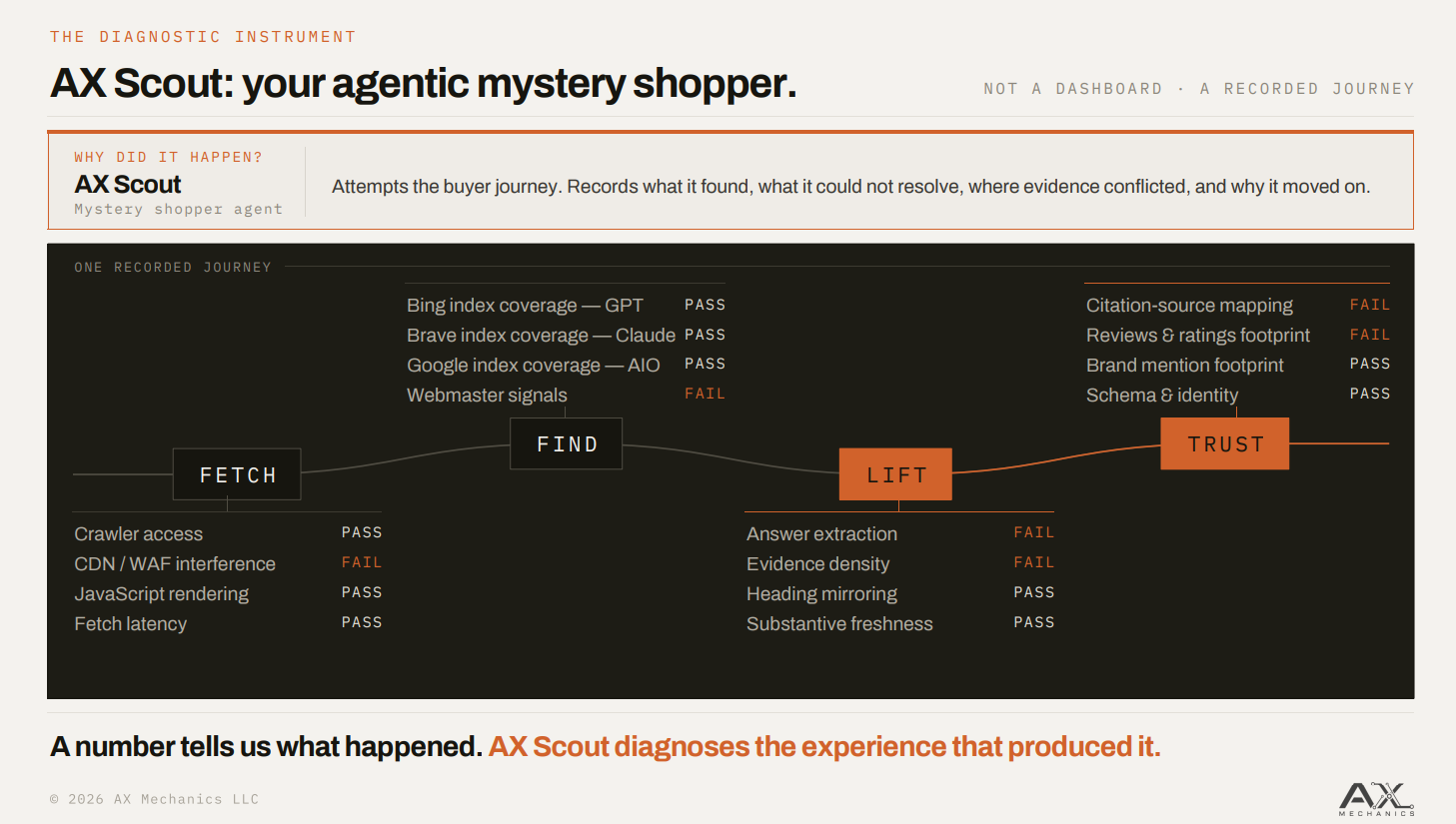
AX Scout attempts the buyer journey as an AI agent would. It investigates whether the business can be reached, found, understood and trusted—recording what it discovered, what it could not resolve, where evidence conflicted and why it moved on.
What it demonstrates
A recorded AI buyer journey across the four gates: Fetch, Find, Lift and Trust
Diagnosis of why a company is—or is not—appearing in AI-generated answers
Clear separation between deterministic checks, model judgment and human decisions
Repeat testing to confirm that judgment-based findings are consistent
An explicit “inconclusive” result when the available evidence does not support a reliable answer
Client application
Diagnostic and analytical agents that investigate complex conditions, preserve the evidence behind every finding and explain why they reached a conclusion.
A visibility score tells you what happened. AX Scout diagnoses the experience that produced it.
GTM Brief Research Agent
Do the research before the meeting. Use the meeting to find what matters.
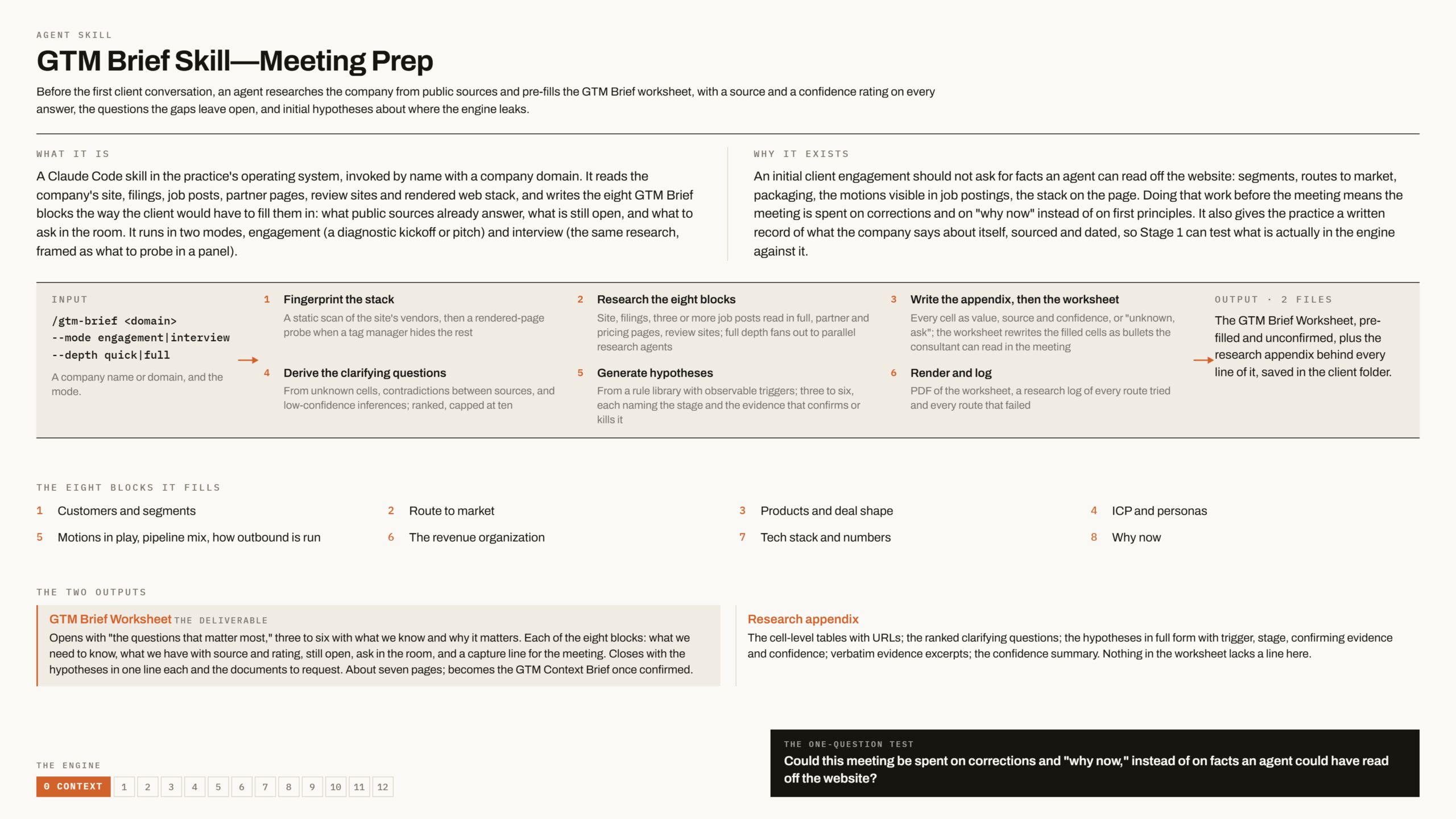
Before a client or prospect conversation, the agent researches the company across its website, filings, job posts, partner pages, review sites and visible technology stack. It produces a sourced GTM brief showing how the business appears to operate, what remains uncertain and which questions are worth asking.
What it demonstrates
Research across multiple public sources, including rendered websites
GTM context spanning customers, routes to market, products, buying audiences, revenue motions, organization, technology and “why now”
A source and confidence rating behind every finding
Clear separation between verified facts, company claims and unvalidated hypotheses
Prioritized questions derived from gaps, contradictions and low-confidence findings
Client application
Pre-call research, account planning and discovery preparation that gives sellers and consultants a credible starting point before the conversation begins.
The agent gathers the facts. The meeting tests what is true, what has changed and what matters now.
01 / 06Next · Dinnerbell Agent
A working system with an owner—not a prototype left behind.
What you receive
Depending on the job, the finished system includes:
System
A production agent, agentic workflow or automation
Connections to the required business systems
Context and knowledge architecture
Controls
Defined tool permissions and operational guardrails
Human approval and escalation paths
Evaluation
An evaluation harness built from real cases
Monitoring and operational visibility
Ownership
A runbook, documentation and ownership model
The result is a system your organization can operate, evaluate and improve—not a demonstration that disappears after the presentation.
Frequently asked questions
Agent development
An agent uses model judgment to decide how to complete a task. An agentic workflow is a defined process with one or more agents inside it, where some steps use judgment and others follow fixed rules. Automation handles work that doesn’t need judgment at all.
Most production systems combine all three. Deciding which parts of the job belong to which is one of the first things we do.
Usually, yes, but it moves quickly when the use case is clear. The sprint confirms the outcome, the workflow around it, the systems the agent needs to reach, and the controls it needs before anything is built.
Sometimes it confirms the design you had in mind. Sometimes it shows that a narrower agent, a workflow or simpler automation will do the job more reliably.
The Agent Spec: a build-ready specification covering the job, workflow, human checkpoints, system access, tool permissions, evaluation plan, architecture, success measures and build scope.
It’s written so the system can be built from it, whether we build it or your team does.
Reliability is engineered rather than assumed. Each system has an evaluation harness built from real cases, defined tool permissions, clear handling for uncertain or failed steps, and monitoring once it’s live.
Model upgrades are tested against the same evaluations before they reach production.
Wherever judgment, risk or your company’s name is on the line. We design human checkpoints into the workflow, such as approving outreach before it sends or reviewing a recommendation before it’s acted on, and escalation paths for anything the system can’t resolve.
We build around the systems you already run, including CRM, marketing automation, data platforms, advertising accounts and internal tools, using APIs, MCP and orchestration platforms where they fit.
Technology choices follow the job and your existing architecture rather than a preferred vendor.
We keep evaluating and monitoring quality, cost, adoption and failures, test model upgrades, and work through a prioritized improvement backlog as the work and the technology change.
You also receive a runbook, documentation and an ownership model, so your team can operate and improve the system itself.
Put AI to work on a job that matters.
Bring us a real use case. We’ll turn it into a reliable production agent or agentic workflow.