
For the last decade or more, managing online visibility was a consistent discipline. A buyer searched, a search engine ranked pages, and marketing worked to make sure the right page appeared high enough to get the click. AI changes more than just the interface. Increasingly, the machine is doing more of the buying work itself.
Gartner found that 45% of B2B buyers used AI during a recent purchase. In its 2025 buyer research, 6sense found that 95% of eventual winners were already on the buyer’s Day One shortlist. That list increasingly comes from AI recommendations. If buyers are handing research, comparison, and validation to AI—and early consideration largely determines who wins—then visibility is no longer just about whether a buyer can find your website. It is increasingly about whether a machine can find enough credible evidence to understand your business, evaluate it against alternatives, and ultimately recommend it.
That’s what we mean when we talk about AI Visibility:
AI Visibility is the outcome of how AI systems discover, understand, evaluate, and ultimately recommend a business.
Over the last several months, we’ve reviewed the academic research, commercial studies, and platform documentation on what actually influences whether a brand, product, or service is surfaced and recommended by AI systems. We’ve distilled that evidence into a practical framework for improving AI Visibility—and found that many widely promoted “best practices” are either unsupported, ineffective, or sometimes actively harmful. The result is a simpler question: what conditions actually matter, and where should you focus?
AI has become a buying interface
The easy interpretation is that this is another channel shift: buyers used to type a question into Google, now many of them type it into ChatGPT, Claude, or Perplexity. The more consequential change is what happens after the question gets asked. Google has confirmed that AI Mode and AI Overviews may use query fan-out — issuing multiple related searches across subtopics and data sources to develop one response. Microsoft now exposes some of the corresponding grounding queries behind its own AI answers through Bing Webmaster Tools.
So, a buyer asking for the “best enterprise platform for X” may actually trigger a much larger research exercise underneath the surface…which vendors serve enterprises, how the products compare, what they integrate with, what customers say, what the limitations are, and whether the online sentiment backs it up.
One prompt can become a research tree. And instead of handing that research back to the buyer as ten blue links on a search engine result page, the machine synthesizes what it finds into an answer. Microsoft describes grounding as the layer connecting the model to current, authoritative information beyond its training data — increasingly putting the agent, rather than the person, in the role of researcher. That changes what it means to be visible.
SEO is still the foundation
SEO is not dead, and AI Visibility is not a replacement for it. Google explicitly says its existing SEO fundamentals remain relevant to AI Overviews and AI Mode. A page still has to be indexed and eligible for Google Search before it can appear as a supporting link, and Google says there are no special technical requirements beyond the normal Search foundation.
But Google is no longer the only game in town. Research indicates that ChatGPT grounds much of its search indexing on Bing. Anthropic lists Brave Search as a web-search sub processor for Claude. Perplexity—with its strong citation focus—runs its own search indexing. OpenAI operates OAI-SearchBot specifically to surface websites in real-time ChatGPT search, while Anthropic documents separate search, user-triggered retrieval, and training crawlers.
So traditional crawlability, indexation, relevance, authority, and useful content remain table stakes. The mistake is assuming that it’s the whole game. Once the machine is doing the reading, synthesizing, corroborating, and recommending, additional requirements come into play. Can the relevant systems access the evidence? Is the business present in the specific search indexes they consult? Can the machine extract a useful answer once it finds content on owned channels like your website? Does the wider evidence ecosystem reinforce or contradict what the business says about itself?
Those requirements move beyond traditional SEO. We organize them around four questions: Fetch, Find, Lift, and Trust.
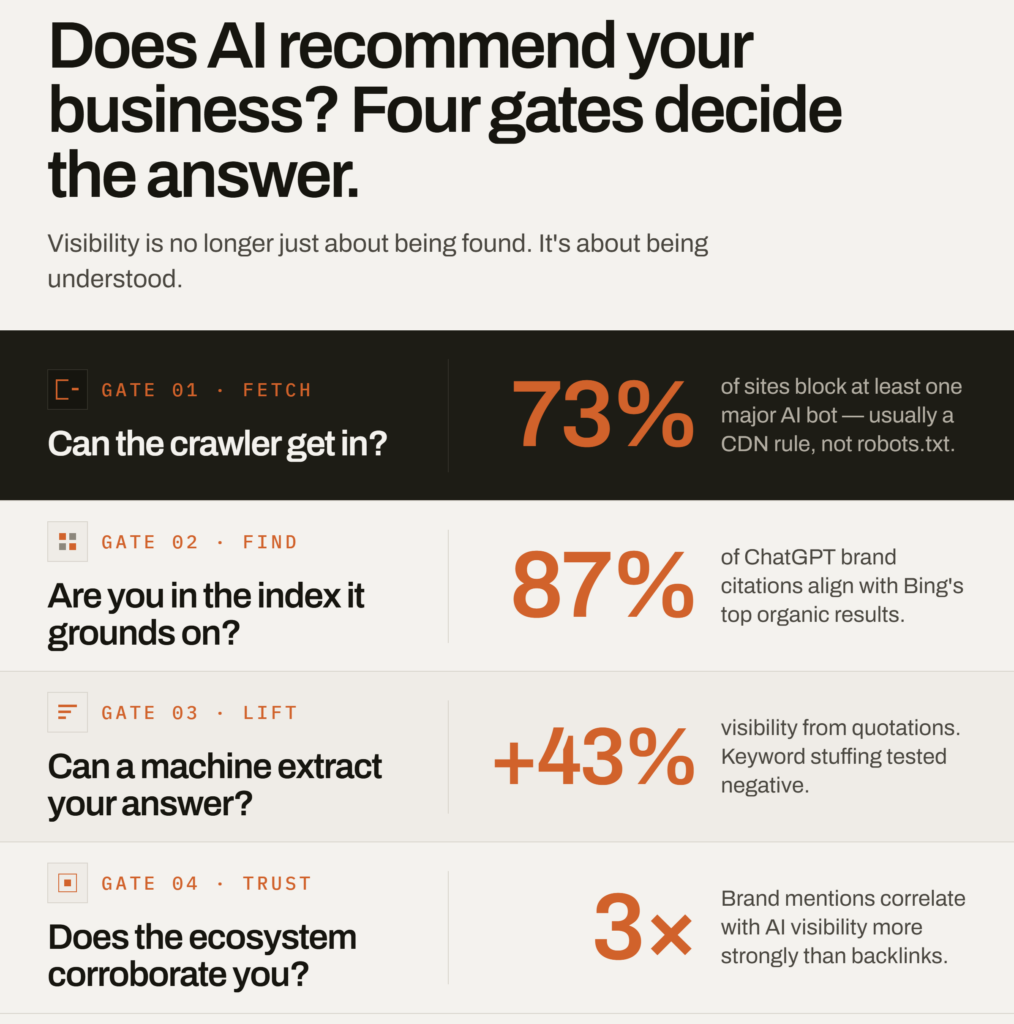
FETCH — Can the machines even access your content?
FETCH is the technical foundation of AI Visibility: can the systems you care about actually reach and read the information you want them to use?
That sounds straightforward, but access is increasingly platform- and purpose-specific. AI companies operate different crawlers for search, user-triggered retrieval, and model training. OpenAI, for example, separates OAI-SearchBot from GPTBot. Anthropic similarly distinguishes search, user, and training crawlers. So “are we blocking AI?” is too basic a question. A company may intentionally restrict model-training access while still wanting its content available to AI search, and the configuration needs to reflect that deliberate policy decision
Robots.txt is only one layer. CDN and WAF policies can block or challenge crawlers even when robots rules allow them. And JavaScript-heavy pages may expose different amounts of content depending on how a platform retrieves or renders the page. The practical issue is not whether a site uses JavaScript or has bot protection. It is whether decision-critical content is actually available to the AI systems and retrieval paths that matter.
If FETCH fails, the rest of the optimization work on that evidence has little value. A machine cannot cite, quote, or verify from information it cannot reliably ‘see.’
| Probe | What it tests | Why it matters |
| Per-bot crawler policy | Reads rules for search, user-directed, and training bots separately rather than reducing them to “AI allowed / blocked.” | Search visibility and future training access are different decisions. Blocking one does not imply blocking the other. |
| CDN / WAF interference | Looks beyond robots.txt to identify challenge pages, bot-management rules, and the layer actually serving the response. | A crawler can be allowed in robots.txt and still never receive the page. |
| Raw-vs-rendered content | Compares meaningful content in raw HTML with the rendered DOM, weighted toward priority pages. | JavaScript dependency is not automatically fatal, but it can reduce the depth and freshness available through some retrieval paths. |
| Fetch latency | Checks whether important pages complete inside practical fetch windows rather than treating raw speed as a citation multiplier. | Speed is best understood as a threshold: once the fetch fails, nothing downstream matters. |
| Real-fetch validation | Where possible, validates the content received through the genuine platform retrieval path. | It resolves the cases an external crawler simulation cannot and prevents good security from being mislabeled as a visibility failure. |
The point of FETCH is not to open every door to every bot. It is to know which doors are open, to whom, and why. Crawler policy has become a business decision.
FIND — Are you present where the systems actually go looking?
FIND is about retrieval coverage: when an AI system decides it needs outside information, are your pages and your brand present in the indexes and sources it searches?
There is no single AI index. Google’s AI experiences draw on Google Search. Microsoft uses Bing as a grounding layer. Other assistants rely on different retrieval environments and source mixes, which means strong visibility in one ecosystem does not guarantee visibility in another.
That makes FIND less about “ranking in AI” and more about being present in the right search indexes and retrieval systems. A company can be technically accessible and still disappear from an answer if the relevant pages are missing from the index an engine consults, poorly represented there, or absent from the third-party sources that surface for the question. The practical implication is that index coverage has to be managed as an overall portfolio. Google still matters enormously, but Bing and other indexes can create blind spots that conventional SEO programs may not be watching.
And because some platform relationships are officially documented while others are reverse-engineered from observed behavior, FIND also requires that we optimize against what the evidence shows, and constantly retest and revalidate as the unseen, underlying architectures change over time.
| Probe | What it tests | Why it matters |
| Google index coverage | Whether priority pages are indexed and competitive in Google for the questions that matter. | Classic SEO remains the entry ticket to Google’s AI features. Sometimes the “AI problem” is simply an SEO problem. |
| Bing index coverage | Whether important commercial pages are present and discoverable in Bing. | Bing is an important AI grounding environment that many marketing teams have largely ignored for years. |
| Secondary-index coverage | Checks other relevant indexes where evidence supports a platform relationship. | Different AI products expose different portions of the web. Coverage has to be managed as a portfolio. |
| IndexNow / webmaster setup | Verifies supported mechanisms for pushing updated content into an index and accessing first-party diagnostics. | When freshness matters, passive rediscovery is unnecessary if the platform provides a push mechanism. |
| Grounding-query analysis | Examines the pages actually cited and the intermediate queries surfaced through Bing’s AI Performance report. | It provides rare first-party evidence of what the retrieval layer actually searched for, rather than a simulation of what it might have searched for. |
If a buyer asks one question and the machine decides it needs six adjacent ‘fan-out’ searches before it can construct the answer, those grounding queries tell us something traditional keyword reporting never did: what evidence the machine decided it needed before it was willing to answer. That leads directly to LIFT.
LIFT — Can the machine turn what it finds into a usable answer?
LIFT is about answerability: once an AI system finds your content, can it extract a clear, useful, well-supported answer from it, and is your own first-party content optimized for the machine to use it in the answer? The system still has to identify the relevant passage, understand the claim, evaluate the supporting evidence, and combine it with other sources. A page can rank well and still be poor source material if the answer is buried, ambiguous, unsupported, or trapped in a format that is difficult to extract.
This is where content structure and evidence start to matter differently than they do in traditional search. A Princeton-led GEO study found that changes to already-retrieved content could materially improve its visibility inside generated answers, with tactics such as quotations, statistics, and cited sources performing well in the experiment. The important nuance is that this research speaks to selection after retrieval…it does not prove that adding those elements will cause a page to be discovered in the first place.
LIFT is also about coverage. Google’s query fan-out means one buyer question can expand into a cluster of related sub-questions. A company may answer the headline question well but still lose the final response because it has weak or missing evidence on pricing, integrations, implementation, comparison points, or other parts of the buyer’s research tree. This is also why it’s important to spend time researching real-world user questions and prompts, so you’re grounding your content strategy in the queries that real-world users (and their agents) are using.
The practical implication is that content should be built not just to rank, but to be easy to extract and complete enough to support the full decision…direct answers, clear headings, high-performing formats mapped to query intent, credible evidence, and coverage of the questions buyers are actually asking.
| Probe | What it tests | Why it matters |
| Answer extraction | Attempts real buyer questions against priority pages using only retrievable content and logs why answers fail. | Ranking does not guarantee answerability. Missing, buried, ambiguous, or non-parseable information can disappear at the exact moment the machine needs it. |
| Evidence-density audit | Identifies statistics, expert quotations, and cited sources and assesses whether they genuinely support the claim. | Controlled research shows that usable evidence can improve visibility after retrieval. |
| Heading–question mirroring | Compares page headings with the way buyers actually phrase questions. | “Our Solutions” tells the retriever little. “How does X integrate with Salesforce?” creates a much clearer target. |
| Intent–format match | Checks whether the format matches the task: comparisons use tables, direct questions get direct answers, processes get explicit steps. | Pre-structured evidence reduces the amount of reconstruction the machine has to perform. |
| Fan-out coverage | Expands priority prompts into likely sub-questions and maps each one to a strong, weak, or absent answer. | You can win the head query and still get pruned from the final answer because important branches are uncovered. |
| Substantive freshness | Compares the stated update date with what actually changed in the page. | Maintaining current evidence is different from simply changing a timestamp. |
| Over-optimization scan | Looks for stuffing, artificial fragmentation, and inherited SEO behaviors that make content less usable. | Generative systems reward usable evidence, not the appearance of optimization. |
There is a common thread through those probes: make less work for the machine. A comparison table is already a comparison. A direct answer beneath a question-shaped heading is already an answer. A statistic with a named source is already evidence. The goal is not to write strange content for robots. It is to reduce the cost of human…and machine…understanding.
TRUST — What does the rest of your ecosystem say about you?
TRUST is about external validation: once an AI system finds information about your business, does the wider third-party ecosystem corroborate what you say about yourself?
This is where AI Visibility moves furthest beyond the website. AirOps found that 85% of commercial brand mentions in its study came from third-party domains, while Ahrefs found branded web mentions correlated much more strongly with AI Overview visibility than backlinks. These are observational findings…not causal proof…but they point in the same direction. AI systems build their understanding of a business from many sources, not just the business’s own site.
Reviews, comparison sites, industry publications, communities, analysts, directories, partner sites, and visible experts all become part of that evidence. If your website describes you one way but the rest of the ecosystem describes you differently…or barely mentions you at all…the machine has less reason to accept your version of the story.
That makes TRUST less about traditional domain authority and more about corroboration and consistency across the sources AI systems actually rely on (not to say that domain authority isn’t still important).
The practical question becomes: which sources are shaping AI answers in this category, are you present in them, and do they reinforce the position you want the market to understand?
| Probe | What it tests | Why it matters |
| Citation-source mapping | Aggregates the publications, reviews, communities, reference pages, and other domains that repeatedly appear across category AI answers. | Every market develops its own source diet. Authority strategy should begin with what the engines actually use, not a generic list of “AI-friendly” domains. |
| Placement-gap analysis | Checks whether the brand appears in those sources, how it is characterized, and where it appears in list/comparison formats. | Presence is not necessarily binary. Being buried low in a comparison can behave very differently from being one of the options emphasized near the top. |
| Review-platform footprint | Evaluates presence, recency, volume, recurring sentiment, and response behavior on relevant review platforms. | Reviews provide independent evidence of product experience…the evidence is much weaker for simplistic universal thresholds. |
| Community presence | Examines real category discussions to see whether the brand appears, how it is described, and which competitors buyers recommend instead. | First-person discussion provides evidence corporate content can’t manufacture. The right response is authentic participation, not spamming. |
| Expert visibility | Tests whether credible named people behind the company can be found through bios, quotes, bylines, credentials, and talks. | Attributable expertise strengthens both the evidence itself and the earned-media ecosystem around it. |
| Entity resolution | Attempts to resolve the business consistently across its site, major profiles, knowledge sources, directories, and databases. | A system cannot confidently recommend an entity it cannot confidently identify. |
| Boilerplate consistency | Compares how the company is described across owned and third-party properties. | Repeated exposure builds machine understanding; repeated contradictions build ambiguity. |
| Brand-mention footprint | Measures the scale, quality, and trajectory of third-party discussion relative to competitors. | It measures an input into AI understanding, rather than an outcome produced in an AI answer. |
TRUST is ultimately about making sure the public evidence around your business tells a clear, credible, consistent story. Your website is still your most controllable source of truth. It just isn’t the only (or even most important) one.
Parametric vs. Grounded — Two paths, two clocks
AI answers draw on two sources. Parametric memory is what the model learned during training—brand strength, category associations, and general knowledge. Grounded retrieval is what the system searches and reads at answer time—current facts, detailed evidence, and citations. The two work together. Even when an answer is grounded, the model arrives with an existing view of the category that influences which brands come to mind and how the question gets framed. Then retrieval supplies the current evidence.
Parametric memory picks the cast…grounded retrieval supplies the script.
TRUST is the important overlap. A strong third-party article can influence a grounded answer as soon as it is retrieved, while also becoming part of the broader set of content that may train future models. That is why AI Visibility programs need to work on both clocks at once: the fast clock improves the evidence available now…the slow clock builds the market presence models learn over time.
And no, you do not “rank #3 in ChatGPT”
The emerging AEO industry has borrowed a mental model from SEO that doesn’t work for LLMs: the idea that there is a stable position in AI Visibility that you can report on. There isn’t. AI answers are stochastic, so there is no stable “position” equivalent to a search ranking. SparkToro and Gumshoe ran 2,961 repeated recommendation tests and found that identical prompts produced the exact same brand list less than 1% of the time.
LLM output is indeterminate. That doesn’t mean that AI Visibility is unmeasurable. It means that—similarly to political polling or brand impact metrics—it has to be measured through repeated sampling rather than a single observation. The useful question is not “What rank are we in ChatGPT?” but “How often do we appear across the buyer questions that matter, relative to competitors…and is that rate changing beyond normal variation?”
It also helps to separate two outcomes. Mention Rate measures how often the brand appears in answers. Citation Rate measures how often brand-owned content is cited as evidence. Tracking the two separately gives a much clearer picture than collapsing everything into a single “AI score.”
AI Visibility is measurable. It just isn’t measurable like a SERP.
Measure the outcome. Diagnose the causes.
AI answers vary. The conditions behind them are much easier to diagnose. A crawler is allowed or blocked. A page is indexed or it is not. The content clearly answers the buyer’s question or it doesn’t. The sources shaping the category include your business…or they don’t. Other questions require judgment, but they can still be evaluated against evidence rather than treated as guesswork.
That is why outcome measurement and diagnosis are different jobs. The outcome tells you whether you are appearing. The diagnosis helps explain why. A visibility metric tells you how you are showing up. A diagnostic tells you what you can influence and change.
AI Visibility is a system to manage
The more we study this space, the less AI Visibility looks like a collection of tactics for getting cited by ChatGPT. SEO matters. Technical access matters. Content structure matters. Third-party evidence, entity clarity, and measurement matter. What connects them is the machine doing more of the evaluation. That is why AI Visibility is not a new ranking to chase. It’s a system to manage over time.
Today, the immediate question is whether AI systems can find, understand, trust, and recommend your business. As agents begin comparing options, interacting with systems, and taking actions on a buyer’s behalf, the question will become bigger: what happens when the agent actually tries to evaluate and do business with you? That is the emerging territory of Agent Experience (AX)…more to come on that in a future post.
The web was designed around humans finding information. AI systems are increasingly deciding which evidence makes the answer…and which businesses make the shortlist. Marketing now has two audiences to design for: the human buyer and the agent increasingly helping that buyer discover, evaluate, and act.
Questions Marketing Leaders Are Asking
What is AI Visibility?
AI Visibility is the outcome of how AI systems discover, understand, evaluate, and ultimately recommend a business. It is broader than whether a company appears in search results. A business also needs to be accessible to relevant AI systems, present in the sources and indexes they use, easy for those systems to understand, and supported by credible evidence across the wider web.
Why does AI Visibility matter for B2B companies?
B2B buyers are increasingly using AI to research vendors, compare alternatives, gather product information, and validate decisions. That means an AI system may help determine which companies make the buyer’s consideration set before the buyer ever visits a website or speaks with sales. For companies competing in considered-purchase categories, being accurately understood and represented by AI is becoming part of being considered at all.
Why is AI Visibility especially important for challenger brands?
Challenger brands often need to earn consideration against competitors with greater awareness and market presence. When a buyer asks questions such as “What are the best alternatives to X?”, “X versus Y,” or “Which platform is best for my company?”, AI systems are helping construct the shortlist. A challenger that is absent, poorly understood, or weakly supported by evidence can lose before the buyer ever reaches its website.
How is AI Visibility different from SEO?
SEO helps search engines crawl, index, understand, and rank web pages, and those fundamentals remain essential to AI Visibility. But AI systems often go further: they retrieve information from multiple search environments and sources, extract specific evidence, compare claims, synthesize what they find, and construct an answer. AI Visibility therefore includes SEO, but also considers retrieval coverage, answerability, third-party corroboration, entity clarity, and how consistently the market describes the business.
What are the four gates of AI Visibility?
The four gates are Fetch, Find, Lift, and Trust. Fetch asks whether AI systems can access the evidence. Find asks whether the business and its content are present in the indexes and sources those systems search. Lift asks whether the information can be easily extracted and used in an answer. Trust asks whether credible third-party evidence reinforces what the business says about itself. Together, the four gates provide a way to diagnose why a company is—or is not—appearing in AI-generated answers.
Why might my company rank well in Google but still be missing from AI answers?
Strong Google rankings do not guarantee strong AI Visibility. Different AI products may use different retrieval environments, search indexes, grounding queries, and third-party sources. Your content may also be discoverable but difficult to extract, incomplete for the buyer’s question, or contradicted by other evidence. A company can therefore perform well in traditional search while still having gaps across Fetch, Find, Lift, or Trust.
What makes website content more likely to be used in an AI answer?
Content is easier for AI systems to use when it directly answers the buyer’s question, uses descriptive headings, presents comparisons and processes in structured formats, and supports important claims with credible evidence. A comparison table is already structured as a comparison; a direct answer beneath a question-shaped heading is already structured as an answer. The objective is not to write artificially for AI, but to reduce the work required for both people and machines to understand the information.
What content should a B2B company create for AI-driven buyer research?
Start with the questions buyers actually ask while evaluating a category: alternatives, comparisons, integrations, implementation requirements, use cases, limitations, pricing considerations, customer fit, and evidence of results. Then make sure those questions have clear, substantive answers on your site and are supported by credible evidence elsewhere. AI systems may expand one buyer prompt into multiple related searches, so strong coverage of the entire decision tree matters more than optimizing a single page for a single query.
Can you measure whether a brand ranks in ChatGPT or other AI answer engines?
Not as a stable position like a traditional search ranking. AI answers vary across repeated runs, so a single prompt response creates false precision. A better approach is repeated sampling across the buyer questions that matter and measuring outcomes such as how often the brand appears, how often its content is cited, how it compares with competitors, and whether those rates change beyond normal variation.
Where should a B2B marketing team start improving AI Visibility?
Start with the buyer questions that matter most to revenue, particularly the questions prospects ask when comparing vendors and making a shortlist. Test how the business appears across relevant AI systems, then diagnose the causes through Fetch, Find, Lift, and Trust. Fix foundational access and retrieval problems first, strengthen weak or missing answers, and build credible external corroboration where the evidence ecosystem is thin. Measure the resulting visibility through repeated sampling rather than one-off prompts.
Sources
- Gartner, “Gartner Survey Finds 69% of B2B Buyers Turn to Sales Reps to Validate AI-Generated Insights,” May 2026 — survey of 645 B2B buyers; 45% reported using GenAI during a recent purchase, primarily to gather vendor and product information.
- 6sense, 2025 B2B Buyer Experience Report — nearly 4,000 buyer journeys; the eventual winning vendor was on the buyer’s Day One shortlist 95% of the time.
- Google Search Central, “AI Features and Your Website” and “Optimizing for Generative AI Features” — official guidance confirming query fan-out, continued relevance of foundational SEO, Search-index eligibility, and Google’s guidance for AI Overviews and AI Mode.
- Microsoft Bing, “Elevating the Role of Grounding on the AI Web,” February 2026 — defines grounding as the connection between AI and current information beyond model training, and describes agents increasingly acting as retrievers.
- Microsoft Bing, “Introducing AI Performance in Bing Webmaster Tools,” February 2026 — documents URL-level AI citations and grounding-query phrases, providing first-party visibility into part of the retrieval process.
- Microsoft Bing, “New AI Visibility Insights in Bing Webmaster Tools,” June 2026 — expands grounding-query reporting with intent, topic and citation-share data.
- OpenAI, “Overview of OpenAI Crawlers” — official documentation distinguishing OAI-SearchBot, GPTBot and ChatGPT-User, including the separation between search visibility, user-directed retrieval and model-training controls.
- Anthropic, “Does Anthropic Crawl Data From the Web?” — official documentation distinguishing Claude-SearchBot, Claude-User and ClaudeBot for search, user-directed retrieval and model development.
- Anthropic, Subprocessors — lists Brave Search among Anthropic’s subprocessors.
- Perplexity, “Perplexity Crawlers” and Perplexity Search Research — documents PerplexityBot as its search crawler and describes Perplexity’s own large-scale web indexing infrastructure.
- Google Search Central, “JavaScript SEO Basics” — documents Google’s crawl → render → index process and supports the nuance that JavaScript is not simply “invisible,” while retrieval capabilities differ by crawler and system.
- Seer Interactive, “87% of SearchGPT Citations Match Bing’s Top Results,” February 2025 — independent study finding strong historical alignment between SearchGPT citations and Bing organic results. This is observational evidence, not confirmation of OpenAI’s underlying architecture.
- Aggarwal et al., “GEO: Generative Engine Optimization,” KDD 2024 — 10,000-query controlled benchmark showing that changes to already-retrieved content can improve visibility in generated answers by up to approximately 40%, with effectiveness varying by domain.
- AirOps, “Third-Party Sources Drive 85% of Brand Discovery,” October 2025 — analysis of more than 21,000 commercial brand mentions; 85% came from external domains versus 13.2% from brands’ own domains. Vendor research; best treated as directional rather than causal.
- Ahrefs, AI Visibility research across 75,000 brands — branded web mentions showed substantially stronger correlation with AI visibility than backlinks; Ahrefs explicitly cautions that correlation does not establish causation.
- SparkToro / Gumshoe, “AIs Are Highly Inconsistent When Recommending Brands or Products,” January 2026 — 2,961 repeated tests; identical recommendation lists appeared fewer than 1 in 100 times, with identical ordering rarer still.
- Schulte, Bleeker & Kaufmann, “Don’t Measure Once: Measuring Visibility in AI Search (GEO),” 2026 — finds that AI visibility varies across runs, prompts and time and argues for repeated measurement and distribution-based reporting rather than one-off observations.
- Sielinski, “Quantifying Uncertainty in AI Visibility,” 2026 — statistical analysis showing that single-run citation visibility can imply false precision and that many apparent differences fall within the measurement noise floor.